Promumex WMS Fields and Settings
Extensions of SAP Business One
Overview
Produmex WMS extends the standard functions of SAP Business One with concepts that are important for the operational management of items, for example Best Before Date and location code.
Produmex WMS also adds specific parameters to standard SAP Business One functions and they must be set to ensure the proper functioning of Produmex WMS.
It is recommended to avoid the asterisk (*), pipe (|) and apostrophe (’) characters in Produmex or SBO master data because these characters have a special role in Produmex products.
1. Item Master Data
1.1. Item Master Data - main screen

Bar Code
Bar Code is an existing field in SAP Business One. Produmex offers users the possibility to choose the type of barcode:
- GTIN-14 (GS1 Global Trade Item number)
- The system verifies whether this is a correct bar code (according to the GS1 rules).
- GTIN-Variable
- This is also a GTIN-14 barcode, but with a part that conatins information about a certain value (weight, price, etc.).
- This kind of barcode is used nationally and not internationally, that is, some additional configuration must be added so it is possible to know which part of the barcode is variable, and what that values represent. The configuration is done in the Produmex Variable GTIN Configuration (PMX_VGTC) UDT.
- The barcode to be stored should only be the fixed part of the variable barcode, without the check digit.
- Free barcode.
- No restrictions on format
On the scanner it is possible to scan an EAN 13. The system converts it to a GTIN, and checks that GTIN against the barcode on the Item Master Data. If you have valid EAN 13 barcodes, they should be stored in the system as a GTIN, with a leading 0 in front of the EAN 13.
Has PMX Serial Number
In SAP Business One an item can be managed by batches OR serial numbers. Produmex allows for managing an item both by batches AND serial numbers.
Note: The setting does not apply to items that also have SAP serial tracking enabled. The system diplays the following message when clicking Add or Update: The item has SAP serial numbers and PMX serial numbers. Please choose only one of them.
Track Location of Serial Numbers
If it is checked, Produmex keeps track of the location of items with serial numbers (both SAP serial numbers and Produmex serial numbers) by forcing the stock to be on an SSCC. The serial number is linked to that SSCC.
Serial Number Format
It specifies the serial number format as a regular expression. The available formats have to be specified in the Produmex Item Serial Number Format (PMX_ISFT) UDT.
When the Serial Number Format is set, the system checks if scanned serial numbers meet the format requirements. If any serial numbers in stock do not match the criteria, the system will not allow their use. Therefore, it is recommended to set a new format only when there are no items in stock with the old serial number format.
1.2. Item Master Data: Purchasing Data tab
Produmex WMS adds the Mfr Item Descr. field to the Purchasing Data tab of the Item Master Data window.
The field can be used to add a distinctive description to an item and the system displays this description in the name of the item in the Reception Flow and Bulk Reception Flow.
Be aware during Reception Flow and Bulk Reception Flow, items on the Select Product screen are listed according to the Mfr Item Descr. field.
The system checks the custom fields in the following order:
- substituteItemDescr (U_PMX_SIDE)
- Mfr item desc ( U_PMX_VIDE)
- custom item descr (U_PMX_CUDE) → Updated automatically

1.3. Item Master Data: Inventory Data tab

The following columns are added to the inventory grid:
Uom2 Qty Warehouse
This is the quantity for the second UOM that is in stock.
In case it is a catch weight item, this will be the actual weight.
If it is an item with a UOM2, but no catch weight, this will be the calculation of UOM2 based on the default ratio between both UOM.
Uom2 Qty Confirmed
This is the quantity for the second UOM that is committed.
The calculation of UOM2 based on the default ratio between both UOM.
Uom2 Qty Ordered
This is the quantity for the second UOM that is ordered.
The calculation of UOM2 based on the default ratio between both UOM.
Uom2 Qty Available
This is the quantity for the second UOM that is available.
The calculation is: (In stock + Ordered) - Confirmed
Note: The above listed UoM2 columns are filled in only when there is a UoM2 defined.
PMX Free Stock
This is the free stock that is available for Produmex.
This is the sum of the quantity in inventory minus the sum of the quantity that is locked.
(SUM(PMX_INVT.Quantity) – SUM(PMX_INLD.Quantity))
1.4. Item Master Data: Produmex tab
A Produmex tab is added to Item Master Data with fields that are not available in standard SAP Business One.
Important: When duplicating an Item in Item Master Data, only the predefined Zone Type grids carry over to the newly duplicated Item. The standard way to copy bulk data to the new Item is by using Import Data tool.
1.3.1. Inventory

Inventory UoM Name
Inventory UoM is an existing SAP Business One field, with a formatted search on the SAP OUOM table. This table contains all the defined UoMs.
Set the inventory UoM to the lowest sellable unit (for example pieces, cases) to avoid rounding issues. For further information please visit Inventory UoM site.
Number of Decimals for uom1
This field indicates the number of decimals for the first UoM. This is used in flows when entering a quantity.
Uom 2
Uom2 identifies the second UoM for the item.
1 uom 2 =
If a second UoM is defined, the conversion rate between the two UoM’s is entered in this field.
Has best before date
If the item has a best before date, this field has to be ticked.
Has second batch number
Defines whether the item has a second batch number.
Default quantity on logistic unit
Defines whether the item has a default quantity on a logistic unit.
Is used for:
- Splitting a proposal in full pallets/item picking
- Cycle count flows: When configured to propose default quantity, this field is used
- Bulk receiving
- Bulk shipping
- Production: Splitting produced quantity
- Reception: Default quantity when entering quantity
- Reception: When configured to split quantity into multiple logistic units, this is the quantity of a logistic unit
Item storage location type
It defines the item storage location type.
The list is retrieved from the Item Storage Location Type (PMX_ISLT) UDT.
This is used in the Location Suggestions functionality and the item location type can be set for bin locations.
Is logistic carrier
This field has to be ticked if the item in question is a logistic carrier (pallet, europallet, container, …). An item can be a logistic carrier as well as a returnable item, e.g a europallet.
Is logistic unit (GS1)
A logistic unit is an individual unit that has been composed for transport and/or storage and have to be manageable throughout the supply chain. These items are identified by means of the Application Identifier 01 in the GS1 standard.
Has no value
Only applies to logistic carriers. If this is checked, the system will allow to deliver the logistic carrier free of charge to the customer during ad hoc picking – customer collect.
Report label key
The identification of the label that belongs to a specific item.
Report label number of copies
The number of labels that have to be printed for a specific item.
Ask for quantity on item label printing
If checked the system will ask to enter a quantity. This entered quantity is passed to the label. This can be used for instance to put the weight on the label.
Item label printing by packaging type
If checked the system will print item labels based on packaging types. When item labels need to be printed, the user can enter the number of labels by each packaging type + inventory uom. On the Produmex Attributes tab it is possible to set a specific report for each packaging type. Also the number of copies can be set there.
If the global option on Company for automatic printing of item labels during goods receipt is set to true, and the option for printing item labels by packaging type is set to true, the system will print the label for the packaging type linked to the purchase order, of purchase uom in case of receiving without PO.
Seveso class (Hazmat in North America)
With the setting it is possible to define the seveso class the item belongs to. The configuration is available with the PMX_SEVE UDT.
When a purchase order is created for an item, the system checks the current inventory for that item. If the current inventory exceeds the maximum inventory set on the PMX_SEVE table, a warning is shown. Still, the order can be added and the stock can be received on the Mobile Client without any further warning.
Use in WA functionality
Enable this option to use this item for the WA functionality.
Is returnable item
This field is checked if the item in question is a “returnable item” (“empties”).
Non-inventory returnable item code
This field contains the item code of the non-inventory returnable item. This code is used for the delivery and receipt of returnable items (“empties”) and is one-to-one coupled with the inventory item code of the same returnable item. (This is configurable on the organizational structure on the ‘General’ tab of the company)
Force serial numbers during cycle count?
When this option enabled for an item with PMX serial numbers and track location enabled, then serial numbers must be entered during cycle counting operations. Otherwise, it's also possible to just enter the counted quantity.
Note: This option has no effect on SAP serial numbered items.
Zone type code
Apart from indicating a standard location or zone, the user can also specify the zone type code. If such a code is entered, the system verifies upon storing an item whether it can be stored in this zone and prevents the item from being stored in a different zone. This can be used for instance if a product needs to be ‘cooled’. If the product has this zone type, it can only be stored on location within a zone that is also ‘cooled’.
Note: Items with assigned Zone Types during a duplication action will carry over the defined Zone Type to the duplicated Item as well.

Default location or zone code
On this grid a default location or zone can be specified for each warehouse for the item. The default location/zone is shown as information on the handheld.
Select the warehouse from the drop-down list on the Pmx Warehouse Code field. Every warehouse that is managed by Produmex can be selected.
Add the code of the location or the zone on the Default location or zone code field. Only locations or zones that belong to the selected warehouse can be added.
To remove a line, select the line and click on the Delete row button.
Note: Produmex WMS ignores the option if the Use Location Suggestion? setting is enabled on a warehouse level.
1.3.2. Sales

Shelf life delivery
This field specifies the minimum remaining shelf life in days of an item (article) from the moment it is outside the responsibility of the manufacturer/distributor (external shelf life), i.e. the actual period that the product is physically present at the customer and can be sold to the end customer.
The external shelf life is defined by the Best Before Date and means that the product will need to stay good at the retailer for at least a specified number of days before the “Best Before Date”. To guarantee that a product can be sold long enough, the retailer usually requires a minimal external shelf life from the manufacturer/distributor of the product.
Pick type
Will define how an item will be handled during pick list generation and picking.
The list of item pick types is defined on the User Defined table “PMX_IPIT”.
If an item is a of a certain pick type (e.g. ’Handle with care’) and it is indicated on the Produmex Pick List Type (User Defined Table “PMX_PITY”) that a pick list should be split based on the item pick type, this item will not be added to pick list with items of another pick type (e.g. slow mover). In this case two pick lists will be generated.
On the UDT “PMX_UIPT” users can be linked to certain item pick types. If such a configuration exists, the system will only allow the user to pick items that he is allowed to pick. This option is used in the ‘Zone picking’ option on the scanner.
Pick type 2
Apart from the primary pick type, an item can also have a second pick type.
The list of item pick types is defined on the User Defined table “PMX_IPIT”.
If it is indicated on the Produmex Pick List Type (User Defined Table “PMX_PITY”) that a pick list should be split based on item “pick type 2” the system will generate separate pick lists based on this criterion, if applicable in combination with the first pick type.
The configuration for linking it to a user is also available for item pick type 2.
Bulk pick quantity
The quantity (lower or equal than a full logistic unit) for which the system will also allow to pick from a bulk location. This is used on stock allocation to a pick list, when it is selected on the scanner.
Configuration on the Picklist Controller needs to allow picking from bulk, see description of Can the user pick bulk quantity from bulk location? setting.
Example: If bulk quantity = 10 and on the sales order you need 24 items, 20 pieces can be picked from bulk, and 4 from pick location.
Enter reason for sales return
Indicates whether a reason has to be specified when a sold item is returned.
Print label during picking
Set whether item labels need to be printed during picking for this item.
Replenishment: quantity on pick locations
The quantity of that item that should be available on pick locations. Based on the parameters that are set in the “Item-based replenishment generator” the system will check whether there are pick locations with this item where there is a lower quantity than the needed quantity and will replenish these. In the “item-based replenishment generator” it can be specified whether or not the system has to take into account open pick lists, pick lists for a specific due date range, or required quantities for a specific stock coverage period (based on the estimated sales quantity by month)
Estimated sales quantity by month
Estimated sales quantity to be sold by month (1 month = 30 days), to be used for stock coverage calculations. Used by the “Item-based replenishment generator”.
Default quality status for sales return
Indicates the default quality status of a sold item that is returned. The standard possibilities are: blocked, quarantine, released, rejected, returned.
This overrides the general definition of the quality status for sales return.
Allow multiple batches on sales doc.
Indicates whether it is allowed on a sales document to have multiple batches of an item in one line (e.g. ordered quantity cannot be fulfilled by a single batch of a product).
This is for information only.
Allow stock to be locked in advance
When this option is set to true, this item can be used for locking in advance. This means it will be possible to lock the stock for certain customer(s) at the moment the stock is received. (Purchase/production/inventory receipt, warehouse transfer)
Smallest sellable packaging type
Indicates the smallest packaging type of the item that can be sold. This is for information only.
Default log. car. picking
The default logistic carrier that is used for the product (e.g. a CHEP or a EURO pallet, …) on the picking process. This is for information only.
Scan base component
In case items are shipped in a special container (e.g. a crate), it can be indicated that the base component needs to be scanned, instead of scanning the container with the items (the crate as a whole). So a single item in the crate has to be scanned to make sure that the crate is sent containing the right items.
This is used in the Picking flow on the scanner. It uses a BOM to check the base component.
Packing remarks
Specific remarks for packing the item in question which is shown on the RF terminal or touchscreen when handling the item.
Packing image
Image of the specific packing of the item in question (e.g. picture of the kit). This image is shown during Packing and Consolidated packing flow.
Sales remarks pop-up
If checked, the system will show the sales remarks that are specified for the product when selecting the product on a sales document.
Sales remarks
Specific remarks that are shown in SAP Business One when creating a sales order for this item.
Add non-inventory item to pick list
If some non-inventory items need to be on the pick list, this option can be checked. When creating a pick list/proposal, the system will add this item to the pick list/proposal.
This option can only be set for items that are configured to be non-inventory items.
This item can be picked/packed on the scanner/touchscreen. Only the quantity will be asked as this is a non-inventory item.
When the pick list has 10 pieces to pick, and the user only enters 8, the system will register this 8 pieces, but the 2 additional pieces will automatically be skipped, so they will not be picked.
Grid 1: Shelf life by customer and country
Produmex also offers the possibility to define a shelf life per individual customer and/or countries, apart from the general shelf life. This is then taken into account when picking goods (i.e. some goods may still be picked for certain customers or countries, but not for others).
You can enter a shelf life for either just a customer, or just a country, or a combination of both a customer and a country.
Grid 2: Minimum reserved stock per customer
This function makes it possible to reserve a minimum stock quantity of an item for customers.
The following pieces of information are mandatory in the grid:
- Column Card code: The card code of the customer for whom you want to reserve a minimum stock quantity. It can be added manually or selected from the list of Business Partners.
- Column Card name: The field cannot be edited, it is automatically filled in after providing the card code.
- Column Whs: The warehouse where the item is located. it can be added manually or selected from the list of Warehouses.
- Column Minimum stock level: The minimum stock quantity of the given item to be reserved for the customer. Its value can only be numeric and can be added manually or entered with the on-screen keyboard.
- If the item is managed in batch, the locking level is in batch.
- If the item is managed in item, the locking level is item.
When the necessary data is provided, the stock quantity is reserved for the given customer and picklist proposals cannot be created from the reserved stock for a different customer.
The reservation is based on the item/quality level, that is, this functionality does not block a batch from being used. When a proposal is being created, a batch gets locked.
1.3.3. Purchase

Shelf life reception
The minimum number of days a product will have to remain sellable from the moment the system receives the product into inventory (prior to the product’s expiry date).
Enter reason for purchase return
Indicates whether a reason has to be specified when returning a purchased item.
Default quality status for reception
This is the default quality status when receiving the item in question.
Released quality status for reception
The released quality status for reception. This is only used for the Quality status for reception by batch extension of the QS Reception Contr. on Company controller. When the system receives a quantity of this item of a certain batch, the system will check whether there is already a specific quantity of the same batch available with the “released quality status”. If there is such a quantity available, the system will overrule the default quality status and assign the released quality status to the received item.
Expiry def. for reception
Allows to specify the expiry definition for reception as defined in the User Defined Table “PMX_EXDE” – Expiry Definitions
Purchase barcode type
If the purchase barcode differs from the main barcode, the type of this barcode can be filled in. The possible values are: GTIN-14 (GS1 Global Trade Item Number) or a free code. If the user enters a GTIN-14 code, the system verifies whether this is a correct barcode (according to the GS1 rules).
Purchase barcode
Contains the purchase barcode if it is different from the main barcode.
Create SSCC on reception
If checked the system will automatically generate an SSCC on reception if no SSCC was scanned. If unchecked, no SSCC will be created and stock can be manipulated without reference to the SSCC.
If multiple items are received, and at least one of them requires an SSCC, the system will create one.
If no SSCC is created at reception, no put away order will be generated. Items need to be moved through ad hoc movement.
If the items is configured as a serial number, with track location on, this setting needs to be ticked.
Print label at reception
Set whether item labels need to be printed at reception for this item.
Sample quantity
Defines the quantity (in inventory uom) of the sample that should be sent back for inspection. The sample generator will use this quantity to generate the sample order (Sales order).
The generation of the actual sample order is done through the SboNotificationListener.
Weight capture from scale needed
If the setting is enabled, the item must be weighed during the Reception Flow.
Purchase remarks pop-up
Is set to true, the text in the purchase remarks is shown as a pop-up when using this item in a purchase document in SAP.
Purchase remarks
The purchase remarks to be shown when selecting the item in a purchase document in SAP.
Grid: Released quality status reception by supplier
Produmex offers the possibility to define a default quality status on reception per supplier. Enter the supplier card code and select the quality status from the dropdown list.
This option is used in the ‘Reception’ and the ‘Receive from WHS’ flows if the QS reception controller on company is set to the ‘Gets the quality status for reception’ extension.
Remaining Quantity by Default?
The number of items to be shown on the mobile client when scanning the product (remaining based on PO, barcode, etc. or not) can be predefined when the option is selected on the Purchase Delivery Generator. Options are:
- (Y)es
- (N)o
- (C)ompany Default
1.3.4. Production

Default quality status for production
This is the quality status that the stock gets when producing new stock. The setting overrules the general setting.
Default log. car. Production
This is the default logistic carrier for production. If this is set, the system automatically uses that logistic carrier to put the stock on.
Expiry def for production
It allows for specifying the expiry definition for production as defined in the Expiry Definitions UDT.
Auto line up selection
If the setting is enabled, the system automatically lines up the location and does not allow the user to select it.
- This option is used in combination with the production manager.
- Lined-up locations are sorted by location name.
Additional pick for production (%)
When picking for production without a picklist, the system proposes to pick more than the theoretically needed quantity for the production order.
Allowed production deviation (%)
The allowed deviation of the produced quantity. This is used in combination with the Confirm produced quantity after production and Default production quantity setting on the production controller. It checks if the deviation is allowed based on the default quantity to produce.
Deviation from the allowed quantity:
If the deviation from the default quantity exceeds by a specified percentage, only then a warning message will be triggered.
Default production quantity (%)
This is the default quantity on a produced logistic unit. This setting is used in combination with the Split produced quantity into logistic units of default size setting on the production controller.
The Allowed production deviation (%) setting is taken into account during the Confirm produced quantity after production.
Use for time registration
It indicates if the item is used as a time registration type that can be added to a Bill of Material and a production order. The quantity is in hours.
Weigh Strategy
Before starting the Weigh flow you need to create a weigh order for the given item. The Weigh Order window displays the weight strategy that is defined for the item by the Weight Strategy setting. The weigh strategy can be By order or By item. The weighing room drop-down menu of the Weigh order window displays those weighing rooms that have got the same strategy as the item. (The weigh strategy of the weighing room can be set in the Organizational Stucture.)
During the Weigh Flow, you select a weighing room and then the flow continues based on the strategy of the weighing room. For more information click here.
Weight Capture needed during Production
If the setting is enabled, the product / by-product must be weighed with a scale during production.
- The setting applies to the Receipt from Production Flow, Production Flow, Disassembly Flow, and Disassembly - Weight Flow.
- If the setting is enabled, the system displays the Enter the weight screen during the flows.
- If the setting is disabled, the system displays the normal Enter the weight produced screen.
- The setting applies to items that are not managed by serial numbers.
- If the item is a catch weight item, you can weigh the item after the first quantity has been added.
- Prerequisites: There is a scale defined for the production line in the Organizational Structure.

Production remarks
You can add production remarks for the item. This is for information only.
1.3.5. Catch Weight
The weight of catch weight items can be added in two ways:
- Weighing in one step by adding the total weight of the items
- Adding the weight by pieces:
- If the Scan weight for each case setting is disabled, then the system calculates the number of measured pieces based on the measured weight, the UoM conversion and the tolerance. For example Uom conversion is 1pcs = 15kg. When measuring 30, the system automatically calculates that we measured 2 pcs. When receiving 10 pcs, it is possible to add the weight by a single piece or multiple pieces measured together.
- If the Scan weight for each case setting is enabled, then it is possible to weigh by a case. The number of pieces in a case can be set on the # pieces in case field.
Note: It is still possible to add the total weigh.

Catch weight item?
Indicates if the item is a catch weight item.
GS1 AI for uom
The GS1 application identifier to capture the quantity for pieces.
Possible values:
- 37 (Count)
- 31 (Net weight Kilo)
- 32 (Net weight Pound)
GS1 AI for uom2
The GS1 application identifier to capture the quantity for the weight.
Possible values:
- 37 (Count)
- 31 (Net weight Kilo)
- 32 (Net weight Pound)
1 uom = xxx uom 2
The weight of 1 piece.
Weight tolerance (%)
The weight tolerance in percentage. Here it can be defined what the allowed tolerance for the weight is. If the tolerance >= 100, no tolerance check will be done. This check will be used for all documents except: goods issue and goods receipts.
Calculation:
( Pieces * Default weight of 1 piece ) -
( Pieces * Default weight of 1 piece ) * Weight tolerance/100
< Allowed weight <
( Pieces * Default weight of 1 piece ) +
( Pieces * Default weight of 1 piece ) * Weight tolerance/100
Uom to use for purchase
The uom that should be asked when receiving items.
Possible values:
- Pieces (UOM1): The weight is calculated based on the weight of 1 piece.
- Weight (UOM2): The number of pieces are calculated based on the weight of 1 piece.
- Pieces and weight
If the “Uom to Use for Purchase” or “Uom to Use for Sales” is the weight:
It is possible to weigh the individual pieces one-by-one after each other (or multiple pieces measured together) without the need to add the item code again and again. In order to continue, users have to weigh zero.
Example steps for ITEM03 catch weigh item, 1 pcs=15 kg
- Select ITEM03 as item
- Enter weight: weigh 15.1
- Enter weight screen is displayed again, weigh 14.9
- Enter weight screen is displayed again, weigh 0.0
- System proceeds to Add more item screen
On the GRPO, 2 pcs is taken into stock for ITEM03. You can also receive 2 pcs of ITEM03 by first measuring 30.0 then weighing 0.0-
If the “UOM to Use for Purchase” or “UOM to Use for Sales” is pieces and weight, then users should first add the pieces on the Enter Quantity screen and then the weight on the Enter Weight screen, using the scale. In this case, it is also possible to measure by pieces or measure the total weight. If the products are weighed by pieces, the system proceeds to the next step after each piece is weighed.
Uom to use for inventory
The uom that should be asked when moving items.
Possible values:
- Pieces (UOM1): The weight is calculated based on the weight of 1 piece.
- Weight (UOM2): The number of pieces are calculated based on the weight of 1 piece.
- Pieces and weight
Uom to use for sales
The uom that should be asked when delivering items.
Possible values:
- Pieces (UOM1): The weight is calculated based on the weight of 1 piece.
- Weight (UOM2): The number of pieces are calculated based on the weight of 1 piece.
- Pieces and weight
Price calculation for sales
The calculation of the price for creating a sales delivery.
Possible values:
- Price by piece: This option is the default option. In this case no price calculation is done because the price from SAP is already by piece
- Price by weight: The calculation of the price is done by weight.
Price by weight
When a sales delivery/reserve invoice is generated, the price will need to be set when:
- The item is a catch weight item
- The option for price calculation is set to 'Price by weight'
- The base document is NOT an invoice
- Delivery is made through Produmex functionality
The unit price before discount will be adjusted. The default unit price is based on the default weight of a catch weight item. So a recalculation based on the actual delivered weight needs to be done.
The calculation formula is: Unit price before discount = (Unit price before discount sales order / Default weight by piece) * Actual weight) / Quantity
Database columns: DLN1.PriceBefDi = ( RDR1.PriceBefDi / OITM.U_PMX_DQUM) * DLN1.U_PMX_QTY2 ) + DLN1.Quantity
ItemA
* Inventory uom = Case
* Weight uom = Pounds
* 1 Case = 24 pounds (U_PMX_DQUM = 24)
* Price per case = 48$ (= 2$ / pound)
Sales order
* 20 cases
* Unit price = 48$
* Total price = 960$
When we deliver the 20 cases the actual weight = 500 pound (Nominal weight was 480 pound)
The calculation is as follows:
(Unit price sales order / Default weight by piece) * Actual weight) / Quantity = Unit price
(48$/24 pounds) * 500 pounds) / 20 cases = 50$
Total price of the delivery line will be 1000$
This means if you deliver 500 pounds, this is 2$ by pound.
Scan weight for each case
When this is enabled, when scanning/entering the weight in the device, the system will not automatically calculate the number of pieces that would be associated with the weight, but it will use the # pieces in a case.
So on the first entry of the weight, the user can either enter the total weight for all pieces.
Flow:
- Check if scanned weight is within tolerance of the # pieces in case
- Yes: Use the pieces and weight, and ask for next weight
- No:
- Check if the scanned weight is within tolerance of the needed number of pieces
- Yes: Use the needed number of pieces, and total weight
- No: Error is shown that weight is not within tolerance
# pieces in case
This is used in combination with the setting 'Scan weight for each case'.
It stored the number of pieces in a case.
Record weight details during picking
When this is enabled, the entered weight during picking on a device will be stored in a separate table: PMX_WDET.
It stores the pick list doc entry, item and batch details.
This allows to retrieve the detailed weight entry for an item on a pick list.
1.3.6. Attributes

Packaging type
The grid shows the packaging type of the item.
- If the UoM Group of the item is set to manual, it is possible to define a specific packaging type based on the SAP OUOM Table.
- If the item is linked to a defined UoM Group, the system applies the packaging type specified here.
- In the Item Master Data window the Purchasing tab has the Purchasing UoM Code setting and the Sales tab has the Sales UoM Code setting.
- If you open the UoM code list of the settings and remove the same UoM from both lists, the system automatically removes the UoM from the Produmex tab > Attributes tab > Packaging Type Code list. Click
Refreshand the changes are reflected on the Attributes tab. - If you add the UoM to any of the UoM code list again, the system automatically adds the UoM to the Packaging Type Code list of the Attributes tab. Click
Refreshand the changes are reflected on the Attributes tab.
Packaging type code
The packaging type code
Number of UOM 1
The quantity in the packaging, in inventory uom.
Has variable quantity (Goods entry)?
If the quantity for the packaging type can change on each goods entry, this option can be set to true. If the item is batch controlled, the system will ask during goods entry what the quantity in the current packaging type is. This information will be stored, linked to the batch information.
Hide during entering quantity
When this option is set, that packaging type is not shown to the user when he needs to enter the quantity.
Item label report
The specific report that needs to be printed when the option ‘Item label printing by packaging type’ is set to true. When a report is selected, the number of copies need to be more than 0.
# Copies item label
The number of copies that need to be printed in case of option ‘Item label printing by packaging type’ is set to true. If this is set to 0, no item labels will be printed for that packaging type.
Note: To print by packaging type, ensure the item label is configured for the packaging types on the Attributes tab. The system will not use the default item label set on the General tab of OSE. If no label is specified on the Attributes tab, the user will be prompted to print, but no printing will occur.
Batch attributes
If an item has a batch, batch2 or BBD, the system can ask for batch attributes during reception and production.
When a new combination of batch, batch2 or BBD is entered, the system will ask for the batch attributes linked to the item. The values of the batch attributes will be stored into the table PMX_ITBA. There are some predefined batch attribute types. Those batch attributes will be stored also on the table PMX_ITRI.
Batch attribute code
This is a list of batch attribute types defined in the UDT @PMX_BATT
Value entry option at reception
This will set whether he value should be asked during reception
Possible values:
- Required: User will have to fill in the data
- Optional: User can skip entry of the data.
- Hidden: This batch attribute will not be asked during reception.
Is linked to batch?
When this option is set to true, this batch attribute will be linked to the batch number.
This means when a new combination of batch/batch2/BBD is created, and the batch number already exists in the system for this item, the batch attribute is not asked to the user, but the value is copied.
Allergens
This grid stores all the allergens the item can have.
Allergen code
This is a list of allergens defined in the UDT @PMX_ALLE
Can contain allergen?
If this product does not contain the allergen by default, but it is possible that some trace of this allergen could be present, this option can be checked.
1.3.7. 3PL

3PL inbound price
Defines the price to invoice 3PL partners for each received unit (in inventory UoM) of that item.
3PL outbound price
Defines the price to invoice 3PL partners for each delivered unit (in inventory UoM) of that item.
2. Administration
The Administration module of SAP Business One allows for defining important general settings to ensure the proper functioning of the system. Produmex WMS adds specific settings concerning authorizations and users.
2.1. Authorizations
General authorizations for Produmex WMS
At the user level it is possible to define the authorizations for the various functions of Produmex WMS.
An authorized user can define the rights of the individual users. In order to do this select Administration → System Initialization → Authorizations → General Authorizations.

An authorized user can then set the user authorization for Produmex WMS as a whole or for the various parts of it. The authorization levels are:
- Full Authorization
- Read Authorization
- No Authorization
The various aspects to which the authorization levels apply are:
- Organization structure
- Print reception logistic unit reports
- Inventory reports selection criteria
- Inventory report detail
- Change quality status
- Route templates
- Route generation
- Route detail
- Picklist proposal generation
- Generated Picklist proposal detail
- Picklist proposal detail
- Picklist detail
- Open documents
- Move
- Production order step list
- Tracking Tracing Search
- Route planning customer details
- Production step list
- Open Sales Orders
- Audit trail search
- Audit trail
- Interface monitor
- Production manager
- Cycle count select location
- Cycle count processing
- Adjust packaging quantity
- Adjust manual locking
- Move order
- Manual interfacing
- Container
- Advance inventory locking
- Print SSCC
- Change BBD on batch
- Change Batch2 on batch
- Wave report form
- Change batch attributes
- Stock selection
- Cycle count Pmx serial numbers
- KPI Report selection criteria
- 3PL invoicing selection criteria
- Alternate items selection
- Select printer form
- Stock allocation form
- Picklist proposal manager selection criteria
- Picklist proposal manager
- Perform move form
2.2. Users
Additional setting for users
- It is possible to set the language in which the “thin client” application runs for each individual users. To do this select Administration → Setup → General → Users. A user-defined field “Language” has been added there to allow you to set the language code for the user in question. This language is used on the scanner/touchscreen when the user has logged on.

2.3. User defined tables
The user defined tables are available via SAP Tools > Default Forms.
Note: The following user defined tables are no longer used:
- Links between GS1 units of measurement and GS1 measure types (PMX_LUMT)
- Produmex measure types (PMX_PMTY)
2.3.1. Box for WAS (PMX_BFWA)
Definition of all boxes that can be used in the warehouse automation system (WAS).
Box type
The box type can be selected from a list. The list comes from the Box type for WAS UDT.
2.3.2. Box type by item for WAS (PMX_BTIT)
If needed, it can be specified how many items in a certain box type can be stored.
Box type
The box type can be selected from a list. The list comes from the Box type for WAS UDT.
Quantity
The quantity of the item that can be stored in the given box type.
2.3.3. Box type for WAS (PMX_BTWA)
Definition of box types that can be used in the warehouse automation system (WAS).
# Compartments
The number of compartments a box has
2.3.4. Container shipping status (PMX_CSST)
This table holds the shipping statuses a container can have.
Sequence
The sequence is used for the sorting on the combobox on the container management screen.
2.3.5. Defines the weighing scales available to a specific thin-client (PMX_TCSC)
Links a scale to a thin client.
Thin client code
The code of the thin client, as defined in the organizational structure.
Scale def. code
The scale definition code. It can be selected from a list coming from the Defines the weighing scales available to a specific thin-client UDT.
2.3.6. Down time types (PMX_DTTY)
List of down time types. This is used in the time registration module when entering a down time.
2.3.7. List of selectable drivers (PMX_DRIV)
A list of known drivers that can be selected during shipping process.
Is the record canceled?
If it is set to Yes, the record is cancelled. The user cannot select cancelled records when the data is asked on the scanner or the touchscreen.
2.3.8. Freight charges definitions (PMX_FCDE)
Configuration of freight charges that will be added to a sales document.
Freight charges definition code
The line number of the freight to be added.
The freight charges are added on a sales order when it is added. The line number must correspond to a line in the freight charges screen on sales order header:

Freight charges definition name
The name of the freight charges.
Shipping type code
The shipping type code where this freight charge needs to be added.
Cost
The price to be added.
Min. document price
The minimum document price that is required to add the cost.
| Freight code | Shipping type code | Cost | Min document price |
|---|---|---|---|
| 1 | 1 | 30 | 0 |
| 1 | 1 | 20 | 100 |
| 1 | 1 | 0 | 200 |
- If the price is between 0 and 99,999999, a cost of 30 will be added to Freight for shipping type 1
- If the price is between 100 and 199,999999, a cost of 20 will be added to Freight for shipping type 1
- If the price is above or equal to 200, no cost will be added to Freight for shipping type 1
2.3.9. Expiry definitions (PMX_EXDE)
A list of possible expiry definitions. This is used to calculate best before dates.
Days
The number of days to add.
Months
The number of months to add.
Years
The number of years to add.
2.3.10. Hidden Fat Client buttons (PMX_HFCB)
This table holds configuration to hide buttons on flows used in the Fat Client.
This configuration table is intended to be used by consultants who are familiar with the workflows and know how to retrieve the needed information to complete the configuration.
Calling workflow
The work flow that is used.
Title key
The title key of the screen where the button needs to be hidden.
Button key
The button key of the button that needs to be hidden.
Disabled
Check this checkbox to disable the configuration to hide the button.
Pmx User Group
The user group this configuration applies to.
If no user group is set, it applies to all users.
Examples:
- How to hide button 'No PO' on the reception flow
- How to hide button 'Change lined up location' on the production flow

2.3.11. Item storage location type (PMX_ISLT)
This table holds a list of item storage location types.
An item and/or location can have this property.
It is used in the functionality for Location Suggestions.
2.3.12. Link packline to zone table (PMX_LPLZ)
Defines the zone linked to pack lines. This is use on the ‘Consolidated packing’ flow.
The pick list destination location should be on that zone. Also the available stock to pack needs to be stored on that zone.
The level of the zone is 1. This means that the zone you define here needs to be the direct zone of the location.
Name
The code of the user.
Code of the pack line
The code of the pack line, as define in the organizational structure.
Code of the zone
The code of the zone, as define in the organizational structure.
2.3.13. Link usergroup to authorization table (PMX_UGAU)
Define the authorization a user group can have.
User code
The code of the user.
User group code
The user group code. The user group code can be selected from a list. The list comes from the ‘User group for PMX’ UDT.
User authorization code
The user authorization code. The user authorization code can be selected from a list. The list comes from the ‘User authorization definition’ UDT.
Value
The actual authorization.
Possible values:
- Disabled
- Enabled
- Hidden
2.3.15. List of actions for certain events (PMX_EVAC)
Defines actions that can be performed for certain events.
Possible events:
- Open extra documents when another print job within SAP is performed.
This print job needs to be for Sales quotation/order/invoice.
It will get documents defined on the item master data in the column defined.
Configuration:
- Table name = OITM
- Colum name = [a column name within OITM where the path to the document that needs to be opened is stored]
- Object type = The object type for Sales quotation/order/invoice
- Action type = Does not need to be filled
- For event = Does not need to be filled
For event
Defines the event this action is for.
Action type
The type of action that needs to be performed.
2.3.16. List of selectable license plate (PMX_LIPL)
A list of known license plates that can be selected during shipping process.
Is the record canceled?
If set to Yes, the record is cancelled. The user cannot select cancelled records when the data is asked on the scanner or the touchscreen.
2.3.17. List of selectable trailer numbers (PMX_TRNR)
A list of known trailer numbers that can be selected during shipping process.
Is the record canceled?
If set to Yes, the record is cancelled. The user cannot select cancelled records when the data is asked on the scanner or the touchscreen.
2.3.18. List of warehouse to warehouse where serial numbers need to be entered (PMX_WSMM)
Defines whether a PMX serial number needs to be asked when performing a move between warehouses.
From warehouse (PMX)
The source warehouse. This is the code of the warehouse as defined in the organizational structure.
To warehouse (PMX)
The source warehouse. This is the code of the warehouse as defined in the organizational structure.
Ask serial number?
Do serial numbers need to be asked?
Print documents?
Do warehouse documents need to be printed?
2.3.19. Package Dimensions (PMX_PADI)

Depending on the pick list type, the user might have to add the dimensions of the package after a logistic unit is finished during picking and packing. The user can enter the dimensions manually or select a package dimension that was defined on this table.
Code
Internal code of the package dimension.
Name
The name of the package dimension that is displayed on fat client screens.
Is the record canceled? (Y/N)
If checked, it indicates that the record is cancelled and cannot be selected as the package dimension during picking or shipping. Cancelled records can be restored.
Width
The width of the package.
Length
The length of the package.
Height
The height of the package.
2.3.20. Port (PMX_PORT)
This table holds the ports.
It is used for the container management: Port of origin, port of destination.
Normal lead time (in days)
The lead time in days for normal delivery at this port.
This is used for calculation of dates in the container management.
Express lead time (in days)
The lead time in days for express delivery at this port.
This is used for calculation of dates in the container management.
2.3.21. Pmx priority (PMX_PRIO)
The Produmex priorities. This is used on pick list (proposals) and move orders. The system has already 3 predefined priorities:
- High (100)
- Normal (200)
- Low (300)
Sequence
A number defining the order of the priority. The value needs to be unique.
Order is done ascending. This means that 1 has a higher priority than 99.
Is default?
For the default priority this option should be set to true.
2.3.22. Produmex allergen types (PMX_ALLE)
A list of possible values an allergen can have.
This is used on the item master data to select an allergen.
2.3.23. Produmex batch attribute types (PMX_BATT)
The defined batch attribute types can be added to items in the Item Master Data window > Produmex tab > Attributes > Batch Attribute Code drop-down menu.

Convertor
The data is stored in the database as text. The system needs to know what type to convert it to. This can be set with the convertor.
Possible values:
- Int
- String
- Date
- Double
- List
Sequence
The sequence of the defined batch attribute types in the Batch Attribute Code drop-down menu.
The key for translation
The key that will be used for the translation of the title. When this is not set, the system will use MSG_TITLE_BATCH_ATTRIBUTE.<Code of the batch attribute>.
In case there is only 1 language in the company, a title can be entered here directly.
A list of possible batch attributes that can be linked to an item.
Some predefined codes have been added:
- COUNTRY_OF_ORIGIN: Country of origin
- MANUFACTURING_DATE: Manufacturing date
When custom batch attribute types are added, a translation should be added to the system. This translation is used on a device when entering the batch attributes.
The translation node for COUNTRY_OF_ORIGIN looks like:
<PmxLocalizationKey>
    <Canceled>False</Canceled>
    <LocalizationKey>MSG_TITLE_BATCH_ATTRIBUTE.COUNTRY_OF_ORIGIN</LocalizationKey>
    <ApplicationTypeCode>SLIM_SCR</ApplicationTypeCode>
    <LocalizationProperties>
      <PmxLocalizationProperty>
        <Canceled>False</Canceled>
        <LocalizationProperty />
        <ExtensionCode>CONVSTR</ExtensionCode>
        <LocalizationValues>
          <PmxLocalizationValue>
            <Canceled>False</Canceled>
            <LocalizationValue>Enter the country of origin</LocalizationValue>
            <LanguageCode>3</LanguageCode>
          </PmxLocalizationValue>
          <PmxLocalizationValue>
            <Canceled>False</Canceled>
            <LocalizationValue>Vul het land van herkomst in</LocalizationValue>
            <LanguageCode>16</LanguageCode>
          </PmxLocalizationValue>
        </LocalizationValues>
      </PmxLocalizationProperty>
    </LocalizationProperties>
  </PmxLocalizationKey>
The LocalizationKey starts with ‘MSG_TITLE_BATCH_ATTRIBUTE.’
Add the code of the attribute type at the end.
When making a complete valid translation file to import, make sure the root tags are also added:
<?xml version="1.0" encoding="utf-8"?>
<TestRoot>
</TestRoot>
AI
The application identifier. It allows a scanned value from a barcode to be automatically stored in the batch attributes.
2.3.24. Produmex batch attribute valid values (PMX_BAVV)
A list of possible values a batch attributes type can have.
Batch attribute type
The batch attribute type. This is a link to the table PMX_BATT
Value
The possible value for the batch attribute type
2.3.25. Produmex cycle count – other operations filter (PMX_COOF)
Cycle counting can be done during other operations. To have a more flexible way of configuring when such a cycle count can be performed, configuration settings can be defined in this table.
[Days of the week]
Define whether the cycle count during other operations can occur or not on a certain day of the week.
Other operation type for cycle count
The type of operation where the cycle count can be performed.
Possible values:
- Ad hoc picking – Transport (Pick list or route)
- Ad hoc picking – Customer collect.
- Picking
2.3.26. Produmex item pick types (PMX_IPIT)
This lists the possible item pick types. This is used on the item master data on fields ‘Item pick type’ and ‘Item pick type 2’.
This is only used in the Zone Picking Flow.
2.3.27. Produmex Item Serial Number Format (PMX_ISFT)
In the Produmex Item Serial Number Format window serial number formats can be defined. The defined format applies to SAP serial numbers and Produmex serial numbers as well.
In the Serial Format column define the format of the serial number in .Net regular expression (regex). For more information on regex click here.
Example of serial number format:
- (SN)[0-9]{8}
- ^(SN)[0-9]{8}$
Symbols:
- The value in parenthesis ( ) is a constant character-string.
- The value in brackets [ ] defines the range of valid character values, e.g. 0-9, A-Z.
- The value in braces { } defines the length of the character set provided in the brackets [ ].
- The caret symbol ^ and the dollar symbol $ can be used to define the beginning and the end of the serial number pattern.

The defined formats are displayed in the Serial Number Format drop-down menu on the General tab of the Item Master Data window.

2.3.28. Produmex location types (PMX_LOTY)
A list of location types. These types can be selected on the organizational structure – location.
3PL item code
For 3PL invoicing only. The code of the item that will be used on the A/R invoices sent to the 3PL customers. The price of one day of storage in each location of that location type is represented by the 3PL item’s price.
The item must be non-inventory.
3PL active?
For 3PL invoicing only. If disabled, the price for this location type will not be included in the A/R invoices sent to the 3PL customers.
2.3.29. Produmex picklist types (PMX_PLTY)
Open the Picklist types table:
Tools > Default Forms > PMX_PLTY Produmex Picklist tyes

Picklist types are used on picklist proposals and picklists and can affect the following:
- if it is split to multiple picklist proposals or not,
- which users are allowed to pick the pick list (see: user picklist types),
- in which flows it can be picked,
- whether certain dimensions should be added during packing.
For the following Picklist workflows you must enable these settings in the Produmex Picklist types table:
| Picklist Type | Setting | Enable |
|---|---|---|
| Box Pick and Pack | Use for Picking? | Yes |
| Zone Box Picking | Use for Zone Picking? | Yes |
| Prepare carts | Use for multi picking? | Yes |
When creating a proposal, the system determines the picklist type based on the following settings in the mentioned order:
- Picklist type on document. The picklist type can be set on sales orders, sales invoices and warehouse transfer requests.
- Picklist type on business partner. A default picklist type for sales documents can be set for business partners on the Business Partner Master Data.
- Default picklist type. The default picklist type is the 'Standard' picklist type. Do not delete the 'Standard' picklist type as it might lead to errors when creating picklist proposals.
| Column | Description |
|---|---|
| Code | The code of the picklist type |
| Name | The name of the picklist type |
| Split PL on item pick type? | When this is true, several picklist proposals can be created, grouping items with the same item pick type. |
| Split PL on item pick type 2? | When this is true, several picklist proposals can be created, grouping items with the same item pick type 2. |
| Full pallet picklist type | When this is set, the created proposal is split up between full quantity (this is a multiple of the default quantity defined on the item master data) and partial quantity (Item pick). The proposal created for the full pallet have this picklist type. |
| Item pick picklist type | When this is set, the created proposal is split up between full quantity (this is a multiple of the default quantity defined on the item master data) and partial quantity (Item pick). The proposal created for the item pick have this picklist type. |
| Always status picked? | When this is true, the picklist line status after picking will always bePicked, that is, when you pick without a moveable location, the status will not be Packed. Picklists with a type that have this setting, need to go through the Consolidated Packing flow. If any picklist within the same wave has this option, all pickings will follow this setting. |
| Ask weight? | When this is true, the weight of the (master) logistic unit is asked when the logistic unit is finished. The data is stored on the PMX_LUID table. The unit of measure is the Default Weight UoM set on the Display tab of General Settings. |
| Ask length? | When this is true, the length of the (master) logistic unit is asked when the logistic unit is finished. The data is stored on the PMX_LUID table. The unit of measure is the Default Length UoM set on the Display tab of General Settings. |
| Ask width? | When this is true, the width of the (master) logistic unit is asked when the logistic unit is finished. The data is stored on the PMX_LUID table. The unit of measure is the Default Length UoM set on the Display tab of General Settings. |
| Ask height? | When this is true, the height of the (master) logistic unit is asked when the logistic unit is finished. The data is stored on the PMX_LUID table. The unit of measure is the Default Length UoM set on the Display tab of General Settings. |
| Use for production? | When this is true, the picklist can be used for picklists of type Production. When this is false, the picklist type can be used for shipping and warehouse transfer. |
| Use for Picking? | When this is true, the pick list can be used in the Picking flow. At least 1 of the picklists in the flow needs to have a picklist type with this flag enabled. |
| Use for Ad Hoc Picking? | When this is true, the picklist can be used in the Ad Hoc Picking flow. |
| Use for Zone Picking? | When this is true, the picklist can be used in the Zone Picking flow. At least 1 of the picklists in the flow needs to have a picklist type with this flag enabled. |
| Use for multi picking? | When this is true, the picklist can be used in the multi picking flow. |
| Number of pallets | This defines the number of pallets that can be added to a picklist proposal. When the value is higher than 0, the proposals are split during creation. The splitting is done based on the setting on the item master data for the default quantity on a logistic unit. (OITM.U_PMX_DQLU) The system calculates a fill rate of the proposal line, based on this setting. The fill rate of the proposal lines can go up to the defined number of pallets. In case the default quantity on a logistic unit on the item master data is not set (=0), the fill rate of that proposal line is 0. |
| Ask weight Sub SSCC? | When this is true, the weight of the logistic unit is asked when the sub logistic unit is finished. The data is stored on the PMX_LUID table. The unit of measure is the Default Weight UoM set on the Display tab of General Settings. |
| Ask height Sub SSCC? | When this is true, the height of the logistic unit is asked when the sub logistic unit is finished. The data is stored on the PMX_LUID table. The unit of measure is the Default Length UoM set on the Display tab of General Settings. |
| Ask width Sub SSCC? | When this is true, the width of the logistic unit is asked when the sub logistic unit is finished. The data is stored on the PMX_LUID table. The unit of measure is the Default Length UoM set on the Display tab of General Settings. |
| Ask length Sub SSCC? | When this is true, the length of the logistic unit is asked when the sub logistic unit is finished. The data is stored on the PMX_LUID table. The unit of measure is the Default Length UoM set on the Display tab of General Settings. |
| Use for Cash Register Packing? | When this is true, the picklist can be used in the Cash Register Packing flow. |
| Print after item picked | If print event 204 - Picking: after item is picked is set on the Print Events tab of the Organizational Structure, the print event applies to those picklist types where setting Print after item picked is set to true. |
| Num of PL per Wave | Number of picklist per wave: In this column you can add the maximum number of picklists of the given type that has to be grouped into a wave. For more information click here. |
2.3.30. Produmex quality types (PMX_QUTY)
This is the configuration of quality types that can be asked during certain processes. The recorded values are stored in the table PMX_QUVA.
Supported flows:
- Reception
- Bulk reception
- Production
- Production receipt
- Disassembly
Configuration:
Code
The code.
Name
The name.
Convertor
The data is stored in the database as text. The system needs to know what type to convert it to.
This can be set with the convertor.
Possible values:
- Int
- String
- Date
- Double
- List
Document type
The document object type for this quality type. This is the ObjType from SAP.
For the moment only Purchase delivery (=20) and production order (202) are supported.
Remarks
Additional remarks. This is just informational.
Sequence
The sequence the quality type should be shown when entering the data. This is used to sort the quality types. This can be any numeric value.
Moment of capture
The moment of capture: When does this quality type need to be asked?
Possible values:
- Start
- End
The key for translation
The key that will be used for the translation of the title. When this is not set, the system will use MSG_TITLE_QUALITY_TYPE.<Code of the quality type>.
In case there is only 1 language in the company, a title can be entered here directly.
When custom quality types are added, a translation should be added to the system. This translation is used on a device when entering the quality values.
The translation node for TEMP_TRUCK looks like:
<PmxLocalizationKey>
    <Canceled>False</Canceled>
    <LocalizationKey>MSG_TITLE_QUALITY_TYPE.TEMP_TRUCK</LocalizationKey>
    <ApplicationTypeCode>SLIM_SCR</ApplicationTypeCode>
    <LocalizationProperties>
      <PmxLocalizationProperty>
        <Canceled>False</Canceled>
        <LocalizationProperty />
        <ExtensionCode>CONVSTR</ExtensionCode>
        <LocalizationValues>
          <PmxLocalizationValue>
            <Canceled>False</Canceled>
            <LocalizationValue>Enter the temperature of the truck</LocalizationValue>
            <LanguageCode>3</LanguageCode>
          </PmxLocalizationValue>
          <PmxLocalizationValue>
            <Canceled>False</Canceled>
            <LocalizationValue>Vul de temperatuur in van de vrachtwagen</LocalizationValue>
            <LanguageCode>16</LanguageCode>
          </PmxLocalizationValue>
        </LocalizationValues>
      </PmxLocalizationProperty>
    </LocalizationProperties>
  </PmxLocalizationKey>
The LocalizationKey starts with ‘MSG_TITLE_QUALITY_TYPE.’
Add the code of the attribute type at the end.
When making a complete valid translation file to import, make sure the root tags are also added:
<?xml version="1.0" encoding="utf-8"?>
<TestRoot>
</TestRoot>
AI
The GS1 application identifier (AI) linked to this batch attribute.
On the flows batch attributes can be entered, based on the batch attributes linked to an item. When a GS1 barcode has been scanned, and a batch attribute needs to be entered with an AI, the system will check if this AI is available in the scanned barcode. If so, this value will be used and the user will not have to manually enter a value for this batch attribute.
2.3.31. Produmex quality valid values (PMX_QUVV)
A list of possible values a batch attributes type can have.
Sequence
The sequence of the valid value in the list. This is used to sort the values to select from.
Quality type
The quality type. This is a link to the table PMX_QUTY
Value
The possible value for the quality type
2.3.32. Produmex user item groups (PMX_UITB)
Here it can be defined what item groups can be visible for a certain user.
This is used on the RF terminals and Produmex screens in the administrative module (SAP).
If the user is not present in the table, he can view data for all item groups.
User code
The code of the user.
Item group
The item group a user is allowed to view.
2.3.33. Produmex user item pick types (PMX_UIPT)
This table is to configure the item pick types a user can pick. If the user is not present in the list, he is allowed to pick all items. If the user is present in the list, he can only pick items with item pick types defined in the table.
This is only used in the Zone Picking Flow.
User code
The code of the user.
Item pick type
The item pick type. The item pick type can be selected from a list. The list comes from the ‘Produmex Item pick types’ UDT.
Item pick type property
The property on the item master data the current line refers to.
Possible values:
- ItemPickType1: The item pick type on item master data.
- ItemPickType2: The item pick type 2 on item master data.
2.3.34. Produmex user picklist types (PMX_UPLT)
This table is to configure the pick list types a user can pick. If the user is not present in the list, he is allowed to pick all pick lists. If the user is present in the list, he can only pick from pick lists with pick list types defined in the table.
User code
The code of the user.
Pick list type
The pick list type. The pick list type can be selected from a list. The list comes from the ‘Produmex pick list types’ UDT.
2.3.35. Produmex user warehouses (PMX_UWHS)
With the Produmex user warehouses UDT you can define the warehouses that can be visible for a certain user. It is used on the RF terminals and Produmex screens in the administrative module of SAP Business One.
If the user is not present in the table, the user can view data for all warehouses.
User code
It can be 25 characters long.
SBO Warehouse
The SBO warehouse that the user is allowed to view.
2.3.36. Produmex variable GTIN configuration (PMX_VGTC)
This table holds a list of configurations of variable GTIN barcodes. The user can store a prefix, define the variable part of the barcode, and what the purpose is of the quantity retrieved from the barcode.

Prefix
The prefix of a barcode that needs to be regarded as a variable GTIN.
This does not need to be the full fixed part of the barcode.
Start index variable part
The barcode has variable part. This field stores the index where the variable part of the barcode starts. This index is zero-based. Supported values: 8, 9, 10.
Length variable part
The barcode has variable part. This field stores the length of the variable part. The sum of the fixed and variable part should be 13 in order to create a GTIN-14 barcode.
# Decimals
The number of decimals of the variable value.
Value purpose (AI)
This defines on what Application Identifier the value needs to be stored, after the value has been captured. Note: Not all listed AI is supported.
2.3.37. Put away zone (PMX_PAZO)
This table holds a list of put away zones. It is used in the functionality for Location Suggestions.
2.3.38. Scale definition (PMX_SCLD)
Configuration of scales that can be used in Produmex RF terminals.
Linked object type
Data needed by the system for the current weighing object. Do NOT adjust values in this column.
Linked doc entry
Data needed by the system for the current weighing object. Do NOT adjust values in this column.
Linked line number
Data needed by the system for the current weighing object. Do NOT adjust values in this column.
Scale setting
Settings for the scale. What needs to be entered here is depending on the scale.
Scale provider type
Provider type for the scale. What needs to be entered here is depending on the scale.
Scale setting
Settings for the scale.
Instance ID
The instance ID
Max. Weight
The maximum weight the scale can handle.
Nr. of decimals
The number of decimals the weight is captured in.
2.3.39. Scale weight result (PMX_SCWR)

Code
The code of the scale. Add the Organizational Structure scale code here.
Name
The name of the scale.
Weigh
The measured weigh. This field will be filled by the ScaleComm Service if the ‘Skip Polling’ option is set to ‘False’ in the configuration file of the ScaleComm Service.
Uom
The Uom of the scale. This field is for information only.
2.3.40. Sequence configuration (PMX_SECO)
This table holds the configuration of sequence numbers.
It is used when Produmex creates a document.
It sets the sequence on a document for the Brazilian localization.
(Like ODLN.SeqCode)
So when a document is created by Produmex, the sequence code for the type of document, and branch is retrieved from this configuration table.
When no configuration is found, no sequence code is set.
Document type
The type of the document.
Like '17' = Sales order, '15' = Sales delivery, …
Branch ID
The branch ID.
Sequence code
The sequence code. This is a numeric value.
2.3.41. Seveso classes (PMX_SEVE)
It defines a seveso class for an item to hold the maximum quantity allowed for the total inventory.

The system checks the total inventory and gives a warning if it exceeds the defined maximum quantity.
Example:
- Maximum quantity = 10
- Stock in warehouse 1 = 251
- Stock in warehouse 2 = 0

2.3.42. Shelf life per country and business partner (PMX_CSSL)
A list of default shelf lives per business partner and country.
These shelf lives are taken into account for items where no shelf life per business partner and country is defined on the item master data. They have however precedence over the general shelf lives defined on the item master data.
You can enter a shelf life for either just a customer, or just a country, or a combination of both a customer and a country.
Country code
The country code (from table OCRY).
Card Code
The card code of the business partner.
Shelf life
The shelf life in days.
2.3.43. Shipping quality option (PMX_SQOP)
In the quality status, it is possible to set the status to “Can Be shipped under quarantine” but still allow shipping. On the sales document line, there is a column (Shipping quality option) to set the allowed quality statuses.

The options for shipping qualities are the following:
- CAN_USE_SUQ: All quality statuses that ‘Can be shipped’ and ‘Can be shipped under quarantine’ are allowed.
- MUST_USE_SUQ: Only quality statuses that ‘Can be shipped under quarantine’ or ‘Can be shipped’ are allowed.
- RELEASED or no selection: Only quality statuses that ‘Can be shipped’ are allowed.
It is allowed to delete an option if it is not needed, but changes to the code are not allowed.
This is used on an SAP document line UDF (Shipping quality option) in combination with the Pick List proposal creation.
Useful Information
Shipping quarantined items can be affected by the following settings:
- Quality Status tab on the Organization Structure:
- Learn more about the Organization tabs:Promumex WMS Fields and Settings
- Learn more about the defined tables:2.3. User defined tables
- Inventory Report: Ensure the Quality Status column is correctly set.
- Sales Order: Adjust the Shipping Quality Option column as needed.
Important Notes!
- Pick locations cannot be used for items labeled as “Quarantined” or “Shipping Under Quarantined (SUQ).”
- Ensure that items with different quality statuses (e.g., Quarantined and SUQ) are not stored in the same location. Mixing items with different quality statuses can cause issues during the picking process.
If items must be shipped even if it's quarantined make sure to set the following settings.
Procedure for Shipping Quarantined Items
- Inventory Report: In the Inventory Report window of the Desktop Client, you have the capability to modify the quality status. Similarly, the Mobile Client also provides the functionality to change the quality status: Change Quality Status Flow.
- Sales Order: On the sales order line, set the Shipping Quality Option to “Shipping under Quarantine”. If you set the “Released or SUQ” option on the Sales Order line during the picking, you can pick from both Released and SUQ stock.
- Organization Structure (OSE): Under the Quality Status tab, enable the “Can be shipped Under Quarantine” setting for the SUQ. This allows SUQ items to be shipped.
Picking and Shipping Flow for SUQ items
- Create a Picklist from the SUQ stock.
- Open the Mobile Client and navigate to Sales > Picking, then select the previously created Picklist.
- On the Identify Pick Location screen, click on Other Task and then Alternate Stock.
- During the standard picking flow, if your stock has an SUQ status, the Identify Pick Location will only work if you select Alternate Stock.
- After selecting the needed alternate stock, the Identify Pick Location screen can be filled.
- On the next screen, Scan a Product and select the product.
- Select a Batch Number. Here, you can see the stock’s quality status: SUQ.
- Finish the picking flow by entering the quantity. Items are successfully picked.
- Continue with the Shipping on the Mobile Client: Sales> Shipping > Select the Picklist and scan the SSCC. The shipping in finished!
Ad Hoc Picking Flow cannot work with “Shipping Under Quarantine” items!
Note:In Ad Hoc picking, it only allows products with the “Can be shipped “ setting on the quality status, even if the shipping quality option has “Can be shipped under quarantine”. The “Can be shipped” status is the strongest point of view and cannot be overwritten by the “Cannot be shipped under quarantine” status.
2.3.44. User authorization definitions table (PMX_UAUT)
Definition of possible authorizations that can be set. This is system information. Do not adjust/delete the code.

Possible values:
- PRD_FLOW_ON_HOLD: The ‘on hold’ button on the Production flow
- PRD_FLOW_STOP_BTN: The ‘stop’ button on the Production flow
- PROPOSAL_CLOSE_BUTTON: The close button to close pick list proposals (Open documents report, pick list proposal form, …)
- PICK_LIST_CLOSE_BUTTON: The close button to close pick lists (Open documents report, pick list proposal form, …)
- WO_OVERRULE_DEFAULT_SCALE: Weigh order: Overrule default scale.
- WO_OVERRULE_SCALE_SWITCH: The ‘Switch scale’ button in the weighing flows.
- WO_OVERRULE_WEIGHT: For weighing outside of the tolerance range in the weighing flows.
2.3.45. User group for PMX (PMX_USGR)
Definition of Produmex user groups. The user group can be linked to a user.

There are already 2 predefined user groups.
- 01_ADMIN: Administration
- 02_SHPFLR: Shopfloor
2.4. Business Partner Master Data

S/P Remarks Pop-Up
If the setting is enabled, the text in the Sales/Purchase remarks is shown as a pop-up when using this business partner in a sales/purchase document in SAP Business One.
Sales/Purchase Remarks
The Sales/Purchase remarks to be shown when selecting the business partner in a sales/purchase document in SAP Business One.
Group Sales Delivery
If various orders for a customer have been entered and picked, it is possible to group the various orders in one sales delivery (Yes) or to have a sales delivery per individual order (No).
Check the following settings:
- Group sales orders for the same customer to 1 delivery? (Y/N)
- Group similar picklists? (Y/N)
Linked Business Partner
In a third party logistics context, a supplier can be linked to a customer so that a purchase order to the supplier can be linked to a sales order to the customer.
Default Currency
The field is used in 3PL Invoicing.
- If the Currency field in the head of the Business Partner Master Data window is set to All Currencies, the value selected in the Default Currency field is used as the Business Partner's Currency.
- If neither the Currency field nor the Default Currency field has a value, the Local Currency field is used on the Basic Initialization tab of the Company Details form.
Picklist Type
In case a default pick list type applies to a business partner, this can be indicated here. When a proposal is created, it will set a pick list type in this order:
- On document
- On business partner (Only for sales proposals)
- Default pick list type
Pallet Packing Type
This is used during packing, consolidated packing,item packing, in combination with allowing to use the pallet packing type on customer (Setting on PackingController).
Possible values:
- Pallet (Default)
- In case master is allowed, then user is asked whether to create master SSCC or normal SSCC
- Multiple identical pallets
- Creates identical normal pallets
- Pallet - Multiple identical sub packages
- Creates 1 master SSCC, but identical sub SSCC's
- Always ask user
- Ask the user how to create the pallets
- Identical master and/or identical sub SSCC's are allowed.
Check to Add Return Items
The setting defines whether the system adds returnable items when booking a document for this business partner or not. Possible values:
- If it is set to Yes, the system adds returnable items when booking a document for this business partner.
- If it is set to No, the system does not add returnable items to the documents of this business partner.
- If it is set to Take Setting on Company, returnable items are added based on the Check to Add Returnable Items setting on the General tab of the Organizational Structure.
Reception
Enter Specific Pallet Nr
If the setting is enabled, a supplier pallet number needs to be entered during reception. This is stored on the table (PMX_LUID) where the SSCC is stored.
If for certain business partners you use that business partner’s own pallets (meaning that these have to be traceable within your company), you can indicate that upon receipt of such a pallet, the pallet number has to be registered.
Has No Logistic Carriers
If checked, the screen to select a logistic carrier will be skipped during the reception process
Has No Logistic Labels
If checked, the screen to scan the logistic label will be skipped during the reception process
Has No Identical Logistic Units
If checked, the screen to choose between identical and non identical logistic units will be skipped during the reception process
Never Delivers Mixed Logistic Units
If checked, the screen to add more items to the logistic unit will be skipped during the reception process
Group Purchase Delivery
If stock is received based on multiple purchase orders from the same vendor, it is possible to group the orders into a single Goods Receipt PO document. Possible values:
- If it is set to Yes, a single Goods Receipt PO document is created for every purchase order that is received in one step.
- If it is set to No, a separate Goods Receipt PO document is created for each purchase order.
- If it is set to Take Setting on Company, the Goods Receipt PO document is created based on the Group Purchase Delivery setting on the Purchase Delivery Generator.
2.5. Shipping types

Produmex has extended the shipping types.
Configuration for pick list/proposals, creation of delivery documents, … can be done here.
When creating proposals, the goods on the sales document can be split up in several proposals, according to settings defined on the shipping type on document line level
Automatic shipping?
If checked, the system will try to automatically create a delivery when the pick list is packed. This setting is taken in account for splitting document lines into several proposals.
Automatic invoicing?
If checked, the system will try to automatically create an invoice when the delivery is made. This setting is taken in account for splitting document lines into several proposals.
The automatic invoicing is only supported for deliveries made by an RF terminal.
Mail report on document add
If checked, a report will be mailed when the document is added. This requires the SBO Notification listener to be installed, and configured to perform the mailing.
Is customer coming to collect?
If checked, the system sets the Customer Collect? setting to true on the generated proposal/pick list screen. This setting is taken into account when splitting document lines into several proposals.
Ask license plate during shipping?
If checked, system will ask for a license plate when performing the shipping. This overrules the setting on global level.
Ask driver name during shipping?
If checked, system will ask for a driver name when performing the shipping. This overrules the setting on global level.
Ask trailer number during shipping?
If checked, system will ask for a trailer number when performing the shipping. This overrules the setting on global level.
Ask tracking number during shipping?
If checked, system will ask for a tracking number when performing the shipping. If it is configured to have multiple deliveries created when shipping (multiple) pick lists, only 1 tracking number is asked, and stored on all deliveries.
The shipping type setting in SBO 9.2.
Disclaimer: This documentation describes the standard SAP Business One shipping type function.
The shipping type can be set in three level:
- Business Partner (On the General tab of the Business Partner Master Data)
- Sales order (On the Logistics tab of the order)
- Item (On the General tab of the Item Master Data)
The default shipping type of a sales order is the shipping type of the customer, but it can be adjusted on the Logistics tab of the order. When changing the sales order shipping type, the system will ask whether to modify the shipping type of the sales order lines as well.
The default shipping type of the sales order lines is the shipping type of the sales order. When adding an item that has a shipping type defined, the shipping type will be automatically set to the item’s default. Changes of the sales order line shipping type will not affect the sales order shipping type.
3. Production
3.1. Bill of Materials
Is base component
Is the current ingredient the base component of the product to produce? (Informational)
This is also used in combination with the ‘Scan base component’ option on item master data.
During picking the user will be asked to scan the barcode of this base component when picking the master item.
Has to be lined up
Does this component need to be consumed from a lined up location?
Qty tolerance %
The quantity tolerance allows flexibility in material usage, enabling slight variations either more or less within a specified percentage range. If there is not enough raw material, the system blocks the receipt from production and displays an error message.
1. Work Order Header (OWOR)
The work order (OWOR) is created from the Bill of Materials (BOM) and defines what and how much should be produced.
Production Order header - OWOR - Product item:
| Column Description | Column Name |
|---|---|
| Planned Quantity | OWOR.PlannedQty |
| Completed Quantity | OWOR.CmpltQty |
Planned Quantity
- The target quantity to be produced.
- Defined when the production order is created.
Completed Quantity
- The quantity that has already been produced and received into stock.
- This value increases with each receipt from production.
2. Production Order Lines – Raw Materials (WOR1)
The raw material components required for production are stored in the WOR1 table. Each line represents one raw material from the BOM.
Production Order lines - WOR1 - Raw material items:
| Column Description | Column Name | Comment / Calculation formula | |
|---|---|---|---|
| Base Quantity | WOR1.BaseQty | ||
| Planned Quantity | WOR1.PlannedQty | = | OWOR.PlannedQty * WOR1.BaseQty |
| Quantity Tolerance Percentage | WOR1.U_PMX_QTYTOLPCT |
Base Quantity
- Defines how much raw material is required per 1 unit of finished product.
- Example:
- 10 breads planned to be produced.
- 1 kg bread requires 0.7 kg flour
- Base Quantity = 0.7 kg
Completed Quantity
- The planned raw material requirement for the entire production order.
- Planned Quantity = OWOR.PlannedQty × WOR1.BaseQty
Quantity Tolerance Percentage
- Defines how much under- or over-consumption is allowed for the raw material.
- Maintained via the Produmex PMX feature.
- Expressed as a percentage.
- Example:
- 10% tolerance: That means the users may consume up to 10% less or more than the calculated requirement.
3. Touch Client
This section applies when the user posts a receipt from production in the Touch Client.
Touch Client - Receipt from production script:
| Steps | Variable Names | Comment / Calculation formula | |
|---|---|---|---|
| Entered Quantity to Produce | EnteredQtyToProd | (entered by user) | |
| Available Quantity of Raw Material | AvailableQty | (queried from stock) | |
| Allowed Deviation | AllowedDeviation | = | (OWOR.CmpltQty + EnteredQtyToProd) * WOR1.BaseQty * (1 - WOR1.U_PMX_QTYTOLPCT / 100) |
| Missing Quantity of Raw Material | MissingQty | = | AllowedDeviation - AvailableQty |
Entered Quantity to Produce
- The quantity the user currently wants to produce.
- Manually entered by the user.
- Example:
- User enters 10 breads to produce in this transaction.
Available Quantity of Raw Material
- The current stock quantity of the raw material - the system using free stock that available at the storage location where production takes place (if there is free stock elsewhere in the warehouse, it does not count).
- Retrieved automatically from inventory.
- Example:
- Available flour in stock = 6 kg (Also referred to as CurrMaterialStock in some contexts.)
Allowed Deviation
This is the core logic that ensures production is allowed only if sufficient raw material exists within the allowed tolerance.
Allowed Deviation = (OWOR.CmpltQty + EnteredQtyToProd) × WOR1.BaseQty × (1 - WOR1.U_PMX_QTYTOLPCT / 100)
- Example:
- Total produced: 10 breads
- Base Qty: 0.7 kg
- Tolerance: 10% (the base quantity can be between 0.63 kg - 0.77 kg)
- Minimum required flour: 10 × 0.7 × (1 - 0.10) = 6.3 kg
Missing Quantity of Raw Material
This value checks whether enough raw material exists.
MissingQty = AllowedDeviation - AvailableQty
- If MissingQty ≤ 0 → sufficient material available
- If MissingQty > 0 → not enough material, the system shows an error that raw material stock is insufficient
- Example:
- Minimum required (allowed deviation): 6.3 kg
- Available: 6 kg
- MissingQty = 0.3 kg
Is the item optional
Set wether the component is optional. If set to true, this component is not required to produce.
Prod. Order start condition
- N = No condition
- Q = Component part. weighed
- W = Component weighed
These are the start conditions of a production order. The requirements need to be met, before the production order can be started.
Best before date option
This is used when picking for production. It configures the way the system should calculate a valid best before date for the ingredient.
Possible values:
- BBD of finished product and shelf life: Take the BBD defined on the production order + shelf life of the ingredient.
- Due date and shelf life: Take the due date of the production order + shelf life of the ingredient
- Pick date: Take the date when the picking occurs or in case of pick lists for production the creation date of the proposal.
Allow to pick for line up? (True/False)
If enabled for a component that has to be lined up, the component can be consumed from every lined up location assigned for the production line, otherwise it can be consumed only from the assigned lined up locations with stock for the item.
Such a component will be added to the pick list (proposal) for production or can be picked for production. When moving the components to the production line, it will be moved to the lined up location selected for the component.
When the ‘Direct consumption of goods’ option is enabled for the lined up location the component is consumed, the component will be automatically issued when the product is received, therefore it will not be listed among the other components on the Production Manager – Stop screen. However, it the ‘Allow to pick for line up setting’ is enabled for the component, it is possible to issue more than the planned quantity, therefore the component will be listed on the Stop screen of the Production Manager.
Weighing needed? (True/False)
Set whether the component must be weighed or not. When creating a weighing order, only components, that have the ‘Weighing needed?’ setting enabled, are added to the weighing order.
Weigh order batch quantity
Add number of batches for the weighing order. If the quantity is greater than 1, the planned quantity of the item to be weighed will be split into multiple weigh order lines. The number of lines is defined by the Weigh order batch quantity value.
Batch attribute & Batch attribute value
This is used when picking for production.
If certain batch attributes need to be picked for production, select the batch attribute type from the dropdown menu in the Batch attribute field. Every batch attribute defined on the Batch attribute types user table can be selected. Then enter the given value to the Batch attribute value field. You can add up to three batch attribute per line.
On the production order, you can also add batch attributes by selecting the ‘Batch attributes’ option from the right-click menu of the line. On the opening Batch attributes control screen you can select the batch attribute type and add/select the batch attribute value.

If a batch attribute is defined for a production line, the stock that can be picked is filtered based on the batch attribute.
3.2. Production order header
Produmex production status
Next to the status of SAP, there is the Produmex production status.
Possible values: Planned, On hold, Started, Closed
Production step list
Next to the item to produce, the user can select a steplist.
The requirements to select a steplist:
- One or more steplists for the item to produce needs to be configured
- The production type needs to be ‘Special’
When a step list is selected, a list of components is created according to the selected steplist.
Production line
Next to the warehouse, the user can select the production line where this production order needs to be produced. Only the production lines in the warehouse are shown.

3.3. Production order lines
The extra fields added to the BOM, are also added to the production order. When creating a new production order, the Produmex add-on will copy the data from the BOM to the production order in case the UDF’s are named the same.
The following fields are used for picking for production: (And not for Pick List for production)
Quantity picked
The quantity that already has been picked for this component.
Batch(es) to pick
If a certain batch needs to be picked for this production order, this column needs to be filled with the batch to pick.
When multiple batches are required, those batches can be entered with a pipe as separator: '|'
3.4. Production issue lines
Is waste?
Is this line registered as waste?
The production batch
This stores the production batch this line was issued for.
4. Resource Master Data
4.1. Produmex tab
Use for time registration (Y/N)
Indicates if the resource can be used for time registration when added to the Bill of Materials or production order.

Organizational Structure
1. Create Company Structure
Overview
In Produmex WMS you can create your company structure by defining Organizational Structure Elements (OSEs). You can define them manually and you can also import zones and bin locations with the Import Tool.
The following elements can be created in the structure:

| Element | Description |
|---|---|
| Company | A company can be created only once per company database |
| Warehouse | The warehouse marks the highest level below a company. It refers to the place where goods are received, stored and from which they are shipped and it can also be the location where goods are transformed (manufactured or packaged). A warehouse in Produmex must always be linked to a warehouse in SAP Business One. |
| Zone | The zone is a specific area in the warehouse where certain functions are grouped (e.g. goods receipt, shipping, packaging, etc.) |
| Production Line | The production line is a line where goods are produced and packaged (as a part of a warehouse). |
| Packing Line | The packing line is a line where goods that are picked on a movable location can be packed onto a logistic carrier to be shipped as a logistic unit. |
| Dock | The doc is a location where goods are received and/or shipped (as a part of a warehouse). |
| Warehouse Automation Location | The Warehouse Automation Location is an automated warehouse (mini load) that manages input and output of items automatically. Produmex does not manage the individual locations (boxes) in the automated warehouse, but keeps track of the inventory on a global level. |
| Bin | The bin is an individual storage location managed by Produmex. |
| Silo Tank | The silo tank is a fixed bulk storage location. |
| Movable Location | The movable location is a movable storage location (e.g. a picking cart) on which goods are temporarily stored after picking and before they are packed on a logistics carrier or used in production (e.g. a forklift). |
| Thin Client | The Thin Client (or Mobile Client / Fat Client) is a fixed or mobile operator station (e.g. a touch screen, a handheld terminal) by which the operator interacts with Produmex. |
| Printer | It marks a printer at a specific location or connected to a specific thin client. |
| Scale | One scale can only belong to a single weighing room / dock / packing station. |
| Weighing room | |
1. Create your company
Create your company in the Organizational Structure and define the general company settings.
1. Go to Produmex menu > Organizational Structure.
2. Right-click on your company, select New OSE and select Company.
3. Fill in the Name and Code fields.
4. Set a default language for your Mobile Client in the Language drop-down menu.
5. Provide your MS SQL / HANA credentials in the DB User Name and Password fields.
6. Fill in the PMX License Server field.
7. Click OK.

2. Define SAP warehouse settings
Define your SAP warehouse settings. Produmex WMS adds the following user defined fields (UDFs) to the SAP warehouse settings:
- Is managed by Produmex?
- Is transit WHS?

There are three possible combinations of the UDFs:
| Managed by PMX | Transit WHS | WMS Terminology | Setup needed in the Organizational Structure | Example | Can be used on scanner |
|---|---|---|---|---|---|
| TRUE | FALSE | WMS warehouse | YES - full setup | Main stock warehouse | YES - full usage |
| FALSE | TRUE | Transit warehouse | YES - only warehouse & dock required | truck, sales employee stock, etc. | YES - Ad-hoc moves, Receive from warehouse, Picking for Transfer Requests |
| FALSE | FALSE | Standard SAP warehouse | NO | Standard SAP Production warehouse, other SAP warehouse | NO |
| TRUE | TRUE | N/A | /N/A | Not possible | N/A |
3. Create PMX WMS warehouses
Create your PMX WMS warehouses in the Organizational Structure and define the warehouse settings.
1. Go to Produmex menu > Organizational Structure.
2. Right-click on your company, select New OSE and select Company.
3. Fill in the Name and Code fields. Use the same code as defined in SAP Business One.
4. Link the warehouse to the SAP Business One warehouse in the Warehouse drop-down list.
5. Click OK.

4. Create additional elements
Define the structure of your company by creating the necessary Organizational Structure Elements, for example create the zones, docks, bin locations of your warehouses.
Example of Organizational Structure

1. Go to Produmex menu > Organizational Structure.
2. Right-click on your company, select New OSE and select the necessary Organizational Structure Element.

3. Provide a code and a name for the element and define its settings.
Tip: You can also import zones and bin locations with the Import Tool. For more information click here.
4. To create a sub-element, right-click on an element in the Organizational Structure, select New OSE and select the necessary sub-element.

5. Define Organizational Structure settings

2. Organizational Structure Settings on Company Level
When you change the data on the tabs of the Organizational Structure, the OK button is enabled. The changes are committed to the database only if you click the button.
2.1. General Settings tab
On the company level general settings can be specified that apply to the entire Produmex WMS add-On.

Language
This includes the standard language (the language that is used by default on the thin clients, unless specified otherwise at the individual user level (cfr. Administration → Users).
Company Logo URL
A reference to the company logo can be added to the field. The path points to a shared folder which contains the company logo used on the login page of the Mobile Client.
DB credentials
The standard connection to the SAP Business One database (username / password). It needs to be set for reporting purposes.
Logistic carriers
It is also possible to define whether logistic carriers (pallets, containers, …) are stored at one location per warehouse (where they are stored after emptying) and what the standard quality status for logistic carriers is.
- Store logistic carriers on 1 storage location by warehouse
When this option is enabled, logistic carriers are stored at one location per warehouse. Set the default storage location for logistic carriers on the Warehouse level.
This setting should be enabled in order to use logistic carriers properly. - Move all logistic carriers on reception
When this option is enabled, logistic carriers are automatically moved to the default storage location of the logistic carriers after the reception.
This setting is only active if the ‘Store logistic carriers on 1 storage location by warehouse’ option is enabled. - Quality status for logistic carriers
Select the standard quality status for logistic carriers from the dropdown menu.
Transport services
These global settings can be overruled on the SAP Shipping types.
- Select Driver When Loading
If the setting is enabled, the name of the driver must be specified or selected when loading. - Select License Plate When Loading
If the setting is enabled, the license plate of the transport vehicle must be recorded. - Select Trailer Number When Loading
If the setting is enabled, the trailer number of the transport vehicle must be recorded.
Goods receipt requires suppl. ref
If the setting is enabled, the operator is asked to enter a supplier reference number during the goods reception process.
- The setting applies to the Reception Flow and Bulk Reception Flow.
- During the flows the system displays a separate Supplier Ref. screen after selecting a supplier and it is mandatory to enter the supplier reference number.
- With the end of the flow the reference number is added to the Vendor Ref. No. field of the created Goods receipt PO document.
Goods receipt automatically prints item labels
If the setting is enabled, the goods receipt on scanner automatically prints item labels. The number of labels printed, is the received number of items. Otherwise the user is asked if printing is needed.
Use inventory returnable items on documents
If the setting is enabled, the returnable item added to the document will be the inventory item.
Note: Depending on the Use Perpetual Inventory setting of the Company Details window of SAP Business One, returnable items work differently in Produmex WMS.
- If the setting is enabled, it is possible to add non-inventory items to the documents based on the Use inventory returnable items on documents setting.
- If the setting is disabled, then inventory returnable items are added to the documents regardless of Use inventory returnable items on documents setting.

Set vat group returnable items on documents
If the setting is enabled, the VAT group of the returnable item will be set when added to the document. For purchase this will be OITM.VatGroupPu and for sales this will be OITM.VatGourpSa.
Check to add returnable items
If the setting is enabled, the system will try to add returnable items when booking a document. To avoid this check this can be unticked.
Disable item selection in flows
If the setting is enabled, it will not be possible to select an item on scanner/touchscreen. The user will always have to scan a barcode to identify the item.
Pick list proposal allowed to exceed order
If the setting is enabled, it is possible to adjust the quantity of the proposal, so it exceeds the ordered quantity.
Do not lock stock on picking (picklists can be created even if no stock is available)
When proposals are made, stock is locked. If the setting is enabled, the system does not lock stock when creating the proposal. This means that there is no more check of available quantity, so proposals can be made, even if there is not enough quantity.
Note:
- Picking can only happen through the Ad Hoc Picking Flow.
- This option does not apply to picklists for production. These picklists will have locking.
- If the Do not lock stock on picking setting is enabled, make sure that you disable the Make Picklist ready before print? setting on the picklist controller.
Allow overpicking
If the setting is enabled, you can pick more items than specified in the sales order/picklist. This can be done for convenience purposes, e.g. if an order for 14 items is received and the packaging unit for that item is a box of 15 items. In such a case, picking a whole box may be more convenient than opening the box and taking one item out.
This option is available for Picking, Zone picking, Multi picking and Ad hoc picking tasks Route and Pick List.
Overpicking is not allowed when picking an alternate stock.
Allow overpicking (Customer collect)
If this setting is enabled, the operator will be able to pick more items than specified in the sales order/pick list in the Ad hoc picking – Customer collect flow.
Count colli after picking
As a further check to ensure the correctness of deliveries, it can be specified that the operator has to count and enter the number of colli that were picked and put onto a logistic unit (SSCC), which the operator wishes to finish. The system will then verify whether this number is the same as the number of colli it has recorded during the picking process onto this logistic unit (SSCC). The count is done in the inventory UoM.
When this is ticked, it can be configured how many times the user can enter an incorrect count.
When this maximum is reached, the picked SSCC is considered unpicked, and a new picklist is created for these items, forcing the user to pick again.
Embed .NET forms in SBO forms
If the setting is enabled, all forms run within SAP.
But in some cases it is useful if some screens are not embedded in SAP. In that case it is possible when you have 2 monitors to move certain screens outside of SAP on another monitor.
This can be done by unchecking this checkbox.
Some screens will be shown in the Windows taskbar, and will be outside of SAP.
Supported screens:
- Organizational structure
- Route planning
- Production manager
- Cycle count – Select location
- Cycle count – Process
Usability Improvement Program
The Usability Improvement Program (UIP) aims to give all Boyum IT customers the ability to contribute to the design and development of Boyum IT products.
By default, the setting is enabled and the add-on automatically sends information to Boyum IT about how the product is used. The information is used to improve the related features.
The gathered data sent to Boyum IT can be:
- feedback: generic information (e.g. SAP version, resolution) and add-on specific information (e.g. number of configurations)
- error
UIP does not send any business data, confidential information or user / customer information. For more information about UIP click here.
If the setting is enabled, an additional Usability Improvement Program tab is displayed in the Organizational Structure window with the following settings:
- Scheduled time to send data: the exact time of the day when information is sent
- Send errors only: If the setting is enabled, only errors are sent to Boyum IT.

Auto-Select Company
If the setting is enabled, the Company element is automatically selected when the Organizational Structure is opened.
Auto-Extend Company
If the setting is enabled, the Company subtree is automatically expanded to the highest level, which is usually the warehouse level, when the Organizational Structure is opened.
2.2. Defaults tab

Labels
In the default settings you can specify the standard labels for goods receipt, shipping and the standard item label.
Additional expenses generator
The setting is used to copy additional expenses, for example freight costs from a sales order/line to a sales delivery.
Generating additional expenses are supported in the following cases:
- Target document: Sales Delivery
Base document: Sales Order or Sales Invoice - Target document: Sales Invoice
Base document: Sales Order or Sales Delivery - Target document: Purchase Delivery
Base document: Purchase Order or Purchase Invoice
Note: The way the costs get divided on the base documents depends on the configuration within SAP. Produmex WMS does not handle it.
Default quality status reception
The default quality status for goods receipt.
This option can be overruled by settings on the item master data.
Released quality status reception
This setting is related to the setting “default quality status reception”. The setting defines the quality status of a batch number that is released in inventory. For example an item with a batch number is received in inventory with a quality status of quarantine (default quality status reception), if the item and batch number changed of quality status to released and the item with the same batch number is again received into inventory it will retrieve the quality status defined in the setting “Released quality status reception”.
This option can be overruled by settings on the item master data.
Quality status sales return
The default quality status for sales return.
This option can be overruled by settings on the item master data.
Quality status cycle counting
Defines the default status of items that are added to the inventory (Inventory Transaction → Goods Receipt) as a result of Cycle Counting (when a positive difference has been established between the actual physical stock in the warehouse and the administrative stock that was registered in SAP Business One). The cycle count default quality status is applied to any stock within or without the SSCC. (Except when the counted bin has a fixed quality status, the surplus stock then gets that quality status)
Quality status returnable items
The default quality status for returnable items.
This is used when inventory returnable items need to be added to the system.
2.3. Extension Parameters tab
On the Extension Parameters tab it is possible to define parameters for certain properties. The properties and the applicable extensions are listed in the Parameter Set, Property and Extension drop-down menus.
The Parameter Set duplication feature allows users to create independent parameter sets based on existing ones. Next to the Parameter Set drop-down menu, there is a “Duplicate” button that triggers the appearance of the modal form/window. This window includes an Original Parameter Set (read-only textBox) and a New Parameter Set (editable textBox). It provides an OK button and a Cancel button. Pressing OK performs the following actions:
- If the New Parameter Set is empty, the OK button is disabled to maintain data integrity.
- If the New Parameter Set is filled, the new parameter set is saved from memory to the database, and the Duplicate Parameter Set window is closed. The newly created parameter set is then loaded. Modifications made to the original parameter set are applicable to the duplicated set. The system supports seamless saving and reloading of modifications for the new parameter set.

Select a property and the applicable extension parameter and the related parameters are displayed.
With the Search Parameters field it is possible to filter the shown parameters. Only parameters that contain the entered characters are displayed.

The following sections describe the available properties and their extensions:
2.3.1. 3PL invoicing controller
2.3.2. Archiving controller
2.3.3. Barcode controller
2.3.4. Batch number 1 on company
2.3.5. Batch number 2 on company
2.3.6. Batch number generator for sales return
2.3.7. Batch number production company
2.3.8. Best before for production generator
2.3.9. Best before for reception generator
2.3.10. Checks controller
2.3.11. Container management controller
2.3.12. Create SAP delivery from PMX delivery controller
2.3.13. Cycle count controller
2.3.14. Document series controller
2.3.15. Freight charges controller
2.3.16. Incoming payment generator
2.3.17. Interface for PMX Advance Shipping Notice importer and exporter
2.3.18. Interface for PMX move im-/export
2.3.19. Interface for PMX move order im-/export
2.3.20. Interface for PMX pick list im-/export
2.3.21. Interface for PMX serial number im-/export
2.3.22. Interface for PMX stock QS change import
2.3.23. Interface for SBO business partner im-/export
2.3.24. Interface for SBO goods issue im-/export
2.3.25. Interface for SBO goods receipt im-/export
2.3.26. Interface for SBO incoming payment im-/export
2.3.27. Interface for sbo item master data im-/export
2.3.28. Interface for SBO production issue im-/export
2.3.29. Interface for SBO production receipt im-/export
2.3.30. Interface for SBO purchase credit note im-/export
2.3.31. Interface for SBO purchase delivery im-/export
2.3.32. Interface for SBO purchase invoice im-/export
2.3.33. Interface for SBO purchase order im-/export
2.3.34. Interface for SBO purchase return im-/export
2.3.35. Interface for SBO sales credit note im-/export
2.3.36. Interface for SBO sales delivery 2 im-/export
2.3.37. Interface for SBO sales delivery im-/export
2.3.38. Interface for SBO sales invoice im-/export
2.3.39. Interface for SBO sales order im-/export
2.3.40. Interface for SBO sales return 2 im-/export
2.3.41. Interface for SBO sales return im-/export
2.3.42. Interface for SBO whs transfer im-/export
2.3.43. Inventory controller
2.3.44. IPmxStockInterface - Pmx stock im-/export
2.3.45. Location controller
2.3.46. Minimum customer stock levels controller
2.3.47. Move controller
2.3.48. On consume for production controller
2.3.49. On release of route controller
2.3.50. On sales delivery creation
2.3.51. Open documents screen controller
2.3.52. Open Sales Orders Controller
2.3.53. Packing controller
2.3.54. Picklist robot
2.3.55. Picking for production controller
2.3.56. Picklist controller
2.3.57. Picklist proposal generator
2.3.58. Picklist proposal manager screen controller
2.3.59. Production controller
2.3.60. Proof of delivery controller
2.3.61. Purchase delivery generator
2.3.62. Put away for order generator
2.3.63. Put away for production generator
2.3.64. Put away for receive from warehouse generator
2.3.65. QS reception contr. on company
2.3.66. Receive from Whs controller
2.3.67. Replenishment generator
2.3.68. Report mailer
2.3.69. Route controller
2.3.70. Sales delivery note generator
2.3.71. Sales return generator
2.3.72. Sample generator
2.3.73. Serial number controller
2.3.74. Stock allocation controller
2.3.75. Track and trace controller
2.3.76. Warehouse automation controller
2.4. Production tab
When the product is produced, the quality status of the product is defined by the Quality Status Production setting on the Production tab of the Organizational Structure.
The available quality status in the drop-down menu are defined by the quality status list set on the Quality Status tab of the Organizational Structure.

2.5. SSCC tab
On the SSCC tab of the Organizational Structure the system shows the current SSCC number and the start and the end number of the range.
The fields prevent the user from entering more than 17 or non-numeric characters. The 18th character is automatically calculated as the check digit.

2.6. Reports tab
2.6.1. Overview
The Reports tab offers an overview of the standard reports that have been defined in Produmex.
It includes a reference to the shared folder (Report path, Coresuite report path) where the reports are stored and makes it possible to set the report parameters:
- Format in which the report is created (for example Crystal Reports, CoreSuite)
- Name
- Page size
- Orientation
- Type
- Path from the entered report path

2.6.2. Configuration
1. Select the format you wish to use from the Format drop-down menu:
- A) Crystal Reports: uses the reports you download with your Produmex installation file.
- B) Crystal Reports by SAP: uses the default reports that are stored within SAP.
- C) Coresuite: uses the reports available in Coresuite.
- D) Unknown: can be used for custom report types.
2. The next step depends on the format you have selected in step 1:
- A) Crystal Reports: Provide the path of the reports in the Report Path field.
- MSSQL:
You can find the reports in your installation folder and you can add its path to the Report path field, for example: C:\Install\Produmex_WMS_X_X.x64\Reports\MSSQL. - HANA: see HANA Report Setting Tool
- B) Crystal Reports by SAP: Check the ID of the report, then add the ID into the Path field. When the system starts printing, it gets the report with this ID from the database.
- C) Coresuite: When printing the system creates a file to a certain folder. The field Coresuite report path needs to be filled in with a folder where the file needs to be stored. The Coresuite add-on picks up the file and prints the report.
3. Provide the necessary report parameters.
- Name
- Page size
- Orientation
- Type: The system uses the report type to provide the necessary data for the flows while printing, see Report table below.
- Path from the entered report path
4. Click ADD and the list of the added reports is displayed in the grid.
2.6.2. Report table
| Report name | Report type |
|---|---|
| Default Goods Receipt Label | Goods Receipt Label (GR-LBL) |
| Default Goods Receipt Label Data matrix | Goods Receipt Label (GR-LBL) |
| Default Goods Receipt Label Small | Goods Receipt Label (GR-LBL) |
| Default Item Label | Item Label (ITM-LBL) |
| Default Logistics Label | New master logistic unit label (MALU_REP) |
| Default Pack List | Sales delivery report (SDEL-RPT) |
| Default Picking Item Completed | Picklist report (PICK-REP) |
| Default Picking Prepare Cart New SSCC Label | Picking prepare cart new SSCC (PPCNSSCC) |
| Default Pick List | Picklist report (PICK-REP) |
| Default Production Label | Production Label (PRD-LBL) |
| Default PT Item Label | Item Label (ITM-LBL) |
| Default PT Item Label 2 | Item Label (ITM-LBL) |
| Default Purchase Order | Purchase order report (PORD-RPT) |
| Default Route Document | Route report (RT-RPT) |
| Default Sales Delivery By Sales Order | Sales delivery report (SDEL-RPT), Sales invoice report (SINV-REP) |
| Default Sales Delivery By SSCC | Sales delivery report (SDEL-RPT), Sales invoice report (SINV-REP) |
| Default Sales Order Confirmation | Sales order report (SALO-REP) |
| Default Shipping Label | Shipping Label (SH-LBL), PMX Sales shipping report (PSSH-RPT) |
| Default Shipping Label Small | Shipping Label (SH-LBL), PMX Sales shipping report (PSSH-RPT) |
| Default Shipping Label With Items | Shipping Label (SH-LBL), PMX Sales shipping report (PSSH-RPT) |
| Default Warehouse Transfer Document | Warehouse move report (WHSM-REP) |
| Default Weigh Order | Weigh order (WO_REP) |
| KPI_Avg Time Picking Report | KPI Average time picking report (KPI_ATP) |
| KPI_Num Deliveries Per Dock Report | KPI sum deliveries (KPI_SDE) |
| KPI_Pick Item Time Report | KPI pick item time report (KPI_PIT) |
| KPI_Pick Lines Per User Report | KPI lines per picker (KPI_LPP) |
| KPI_Time Managment Report | KPI Time management (KPI_TMA) |
2.7. Print Events tab
On the Print Events tab you can indicate which report has to be generated and printed on which event.
The list of print events is available here.

2.6.1. Set up a print event
1. Select the necessary event in the Event drop-down menu.
2. Select the report to be generated upon the occurrence of the event in the Report drop-down menu.
3. Provide the number of copies to be printed in the Number of Copies field. The value provided in the field means that the system prints exactly this number of copies. Value 0 and 1 mean that the system prints exactly 1 copy.
4. Printing
If the Ask operator for reprint in the mobile client? setting is enabled, the system displays the Reprint Label screen on the Mobile Client and asks if more copies should be printed after the given number of copies has been printed.
If the Ask operator to choose printer in the mobile client? setting is enabled, the system displays the Select a Printer screen on the Mobile Client and lists the printers available in the warehouse where the Mobile Client is set. If the setting is not enabled, the system uses the default printer.
5. Optional: In the Filter drop-down menu select a predefined filter, a condition that has to be met for the report to be generated.
The following filters can be selected:
a) Filter by Warehouse Move Matrix UDT(PRFWMM)
The filter can be used for warehouse move documents. It uses the settings of the Warehouse Move Matrix UDT to check whether a document should be printed.
b) Customer Collect (PRFCUCO) and Not for Customer Collect (PRFNCUCO)
- PRFCUCO: The document is only printed for customer collects.
- PRFNCUCO: The document is not printed for customer collects.
These filters can be used for the following print events:
- 200 Picking: new LU full
- 300 Shipping: sales delivery note created
- 302 Shipping: picklist shipped
- 500 Packing: finished LU
c) Document Line (PRFDOCLI)
The filter can be used for print event 204 - Picking: after item is picked and it uses the setting Print after item picked of the Produmex Pick List Types (PMX_PLTY) UDT to check whether a document should be printed.
d) LUID Generated Printed (PRFLUIDG)
When a logistic unit is received with a valid logistic label containing an SSCC, the system does NOT generate a new reception label with a new system-generated SSCC. The filter can be used for the following print events:
- 101 Reception new LU identified
- 200 Picking: new LU full
- 400 Production: LU produced
- 500 Packing: finished LU
- 700 WHS: created LU
- 702 WHS: created master LU
e) Script (PRFSCRIP)
It offers the possibility to develop criteria for determining when and how a label should be printed. Please see section 5.1.6.2. Scripted print filters below.
6. Click Add.
2.6.2. Scripted print filters
It is possible to define a custom print filter. It will allow to block printing for certain parameters.
A typical print filter consists of 3 main sections
- Running of SELECT QUERY to get needed info for document
- Determination of TRUE or FALSE value according to needed info
- Return RESULT
Creation of a new print filter
In the Produmex Organizational Structure go to the Print Events tab.
Here you can add a filter to the desired print event.
Select Filter → IPrintReportFilter – Script (PRFSCRIPT)
Click the Edit button.

The following script editor opens and you can paste the script.

Press the ‘Empty script’ button to open a script template designed for the selected print event. We recommend to use this template instead of starting from an empty script.
The template contains two print report methods.
- Use the first method if the report has only one parameter.
- Use the second method if the report has more than one parameters.
Here you can find a demonstration script that explains what is needed.
Note: In Hana queries are case sensitive. Pls write field names as follows: \“fieldname\” for example: \“CardCode\”
using System;
using System.Reflection;
using Produmex.Foundation.Data.Sbo;
using Produmex.Foundation.Diagnostics;
using Produmex.Sbo.Logex.Data.BusinessObjects;
using Produmex.Sbo.Logex.Data.Providers;
using Produmex.Foundation.Data.Sbo.BusinessObjects;
using Produmex.Foundation.Data.Sbo.Utilities;
using Produmex.Foundation.Data.SqlClient;

public class Script
{
    private static readonly ILog s_log =
			LogProvider.GetLogger(MethodInfo.GetCurrentMethod().DeclaringType);

    public static bool PrintReport(PmxPrintReportEventType eventType, int key, PmxDbConnection dbConn)
    {
        //Create the query you want to use
        string query = "SELECT [COLUMNAME1], [COLUMNAME2] FROM [TABLENAME] WHERE [Key] = "
+ key.ToString();

        //Run the query
        using (ISboRecordset rs = SboRecordsetHelper.RunQuery(s_log, query, dbConn))
        {
            if (!rs.EoF)//Check if you get result from the query
            {
                string var1 = rs.GetTypedValue<string>("COLUMNAME");//Get a string value
                int var2 = rs.GetTypedValue<int>("COLUMNAME2");//Get an int value

                //Possibility to add a check on the result
                //In this case if the value of column with name 'COLUMNAME2' equals to 99,
                //a label should be printed
                if (var2 == 99)
                {
                    return true; //Label will be printed
                }
                else
                {
                    return false; //Label will not be printed
                }
            }
        }
        return false; //Label will not be printed
    }
}
So you can modify this script to fit your needs:
- Modify the query to lookup the needed info
- Get the needed values from the query result
- Modify the check on the result and return the correct TRUE or FALSE
Validate and test

You can also use this screen to:
- Validate the Script
- Do a test run with a KEY from the database :
The key is what is passed to the report. So for the print event ProductionLogisticUnitProduced this is the LUID of the produced pallet.

In order to avoid performance issues, do not use ‘SELECT *’ syntax in the select query. Select only the required columns or the primary key.
Example:
- What should be avoided:
SELECT * FROM "OITM" WHERE "ItemCode" = 'ITEM01'
- What to use instead:
SELECT "InvntItem", "MinLevel" FROM "OITM" WHERE "ItemCode" = 'ITEM01'
SELECT "ItemCode" FROM "OITM" WHERE "ItemCode" = 'ITEM01'
It’s also recommended to add the WITH (NOLOCK) hint to all tables used in these queries.
For example:
SELECT "ItemCode" FROM "OITM" WITH (NOLOCK) WHERE "ItemCode" = 'ITEM01'
- Or with a join (NOLOCK on all tables):
SELECT "OITM"."InvntItem" FROM "DLN1" WITH (NOLOCK) JOIN "OITM" WITH (NOLOCK) ON "DLN1"."ItemCode" = "OITM"."ItemCode" WHERE "DLN1"."ItemCode" = 'ITEM01'
Below you can find another demonstration script which explains how to access more than one parameter in your print filter. It can be relevant as the 204 - Picking: after item is picked print event takes two parameters.
Note: In HANA make sure that you use the parameter of the print event. The list of print events and their parameters are available here.
using System;
using System.Collections.Generic;
using System.Text;
using Produmex.Foundation.Data.Sbo.Providers;
using Produmex.Sbo.Logex.Data.Extensions;
using Produmex.Foundation.Diagnostics;
using Produmex.Sbo.Logex.Data.BusinessObjects;
using Produmex.Foundation.Data.Sbo.BusinessObjects;
using Produmex.Foundation.Data.Sbo.Utilities;
using Produmex.Sbo.Logex.Data.BusinessObjects.Definitions.Tables;
using Produmex.Foundation.Data.SqlClient;
using System.Reflection;
using Produmex.Foundation.Data.Sbo.BusinessObjects.Definitions.Tables;
using System.Globalization;
using Produmex.Foundation.Data.Sbo;
using Produmex.Sbo.Logex.Data.Providers;

public class Script
{
    private static readonly ILog s_log = LogProvider.GetLogger(MethodInfo.GetCurrentMethod().DeclaringType);

    public static bool PrintReport( PmxPrintReportEventType eventType, IDictionary<string,object> parameters, PmxDbConnection dbConn )
    {
    // Only print if we have just picked an item where an UDF on Item Master Data is set to yes, otherwise do not print
    // Adapt this query to your needs
        string query = "SELECT PMX_PLLI.InternalKey, OITM.U_LabelPrint FROM PMX_PLLI" +
                       " LEFT JOIN OITM ON PMX_PLLI.ItemCode = OITM.ItemCode" +
                       " WHERE U_YourUDF = 'Yes' AND PMX_PLLI.DocEntry = " +
                         parameters["@docEntry"].ToString() +
                       " AND PMX_PLLI.LineNum = " +
                         parameters["@lineNum"].ToString();

    //Run the query
        using (ISboRecordset rs = SboRecordsetHelper.RunQuery(s_log, query, dbConn))
        {
            if (!rs.EoF)//Check if you get result from the query
            {
                return true; //Label will be printed
            }
        }
        return false; //Label will not be printed
    }
}
2.8. Zone Types tab
The Zone Types tab allows for defining Zones Types in your company. Zone Types can be assigned to specific items depending on their storage conditions.
Note: When a Zone Type is created, its code cannot be changed.

Needs Reason
Enable the Needs Reason setting if a reason must be provided when receiving or moving the item into a zone with the given zone type.
Show Zone Type
If the setting is enabled, the zone type is shown during the reception of an item.
During the reception of items with zone types, an optional information screen can be displayed to remind the operators in which zone(s) the product can be stored. This is for information purposes only, and while the screen asks the operator to select a zone, no action is taken. The screen is displayed only if the item being received has at least one zone type with the Show Zone Type option enabled.
2.9. Page Sizes tab
The Page Sizes tab allows for defining the page sizes for reports and printers.
Once a page size is created, its code cannot be changed.

2.10. Quality Status tab
The “Quality status” allows you to define the applicable quality statuses for your company.
For each quality status it is possible to define whether or not an item with that specific quality status can be shipped and/or picked for production and/or picked for a replenishment order.
Furthermore you can specify to which quality status a specific status can be changed: e.g. “blocked” can be changed to “released”.

Ask for reason
On the transition between quality statuses the user can set whether a reason needs to be entered for the change.
Can be shipped
The quality status is allowed to be picked and shipped.
Can be picked for replenishment
Indicates if the stock can be used to replenish pick locations.
Can be picked for production
Indicates if the stock can be used pick for production.
Can be used for production
Indicates if the stock can be used for production. Stock that does not have this option, are not allowed to be stored on production lines.
Can be put on a pick location
Indicates if the stock can be stored on pick locations.
Can be shipped under quarantine
Indicates that the stock is in quarantine, but still allowed to ship. Setting ‘Shipping quality option’ on the sales order line can be changed to allow shipment of these goods.
Quality status transitions
This lists the quality statusses to where the current quality status can be changed to.
It is possible to flag the setting Ask for reason. By doing this, when the user changes the quality status through the inventory report, he will have to select a reason for this quality status change.
It is also possible to limit users from making certain quality status transitions.
This is done by selecting a user group for the transaction.
If a user wants to perform a quality status transition, he is only allowed to change it to a quality status that has no user group, or a quality status that has the user group he is assigned to.
Please note that reasons or user group limitations do not apply when moving stock to a location with a predefined quality status.
2.11. Reasons tab
Define the reasons that can be used in Produmex WMS flows on the Reasons tab. A reason might be required to perform certain actions or to explain why a specific action cannot be completed or a specific item cannot be used.
Add the code, name and sequence number of the reason. The sequence number defines the order the reason is shown on the terminals.
Then specify when the reason can be used by checking the corresponding checkbox.
If extra explanation is needed, check the ‘Requires extra reason text’ checkbox as well.

2.12. Connection between Reason & Location suggestion
For more information about location settings follow this link to the Location controller site.
When the location suggestion is enabled, the system will suggest a location for the stock that is being moved in the following flows:
- Reception (In case of receiving on location instead of dock)
- Put away
- Ad hoc moves
- Move orders
- Unpicking for production
- Undo picking
- Consolidated moves

When a destination location needs to be entered these flows will perform the following scenario:
Check if location suggestions are enabled
Enabled:
- Get list of suggested locations
- Show first suggested location on the screen
- Enter a location or select a location
- The list of suggested locations is displayed on the screen after the ‘Select location’ button is pressed
- When the location is not the first suggested location or an empty location:
- Enter a reason
Not enabled:
- Enter a location or select a location
- All valid locations are allowed
Example - Ad Hoc Movement with default location and location suggestion
Let's see a simple example for an Ad Hoc Movement and how to configurate the settings in Item Master Data for in Item that has to be asked for a reason to move to a Zone or out of the the Zone.
1. Make sure you enabled the “Use Location Suggestion?” option in your selected Warehouse where the preferred Zone is located for the Ad Hoc Movement. In this case I will use the GeneralWarehouse (01).
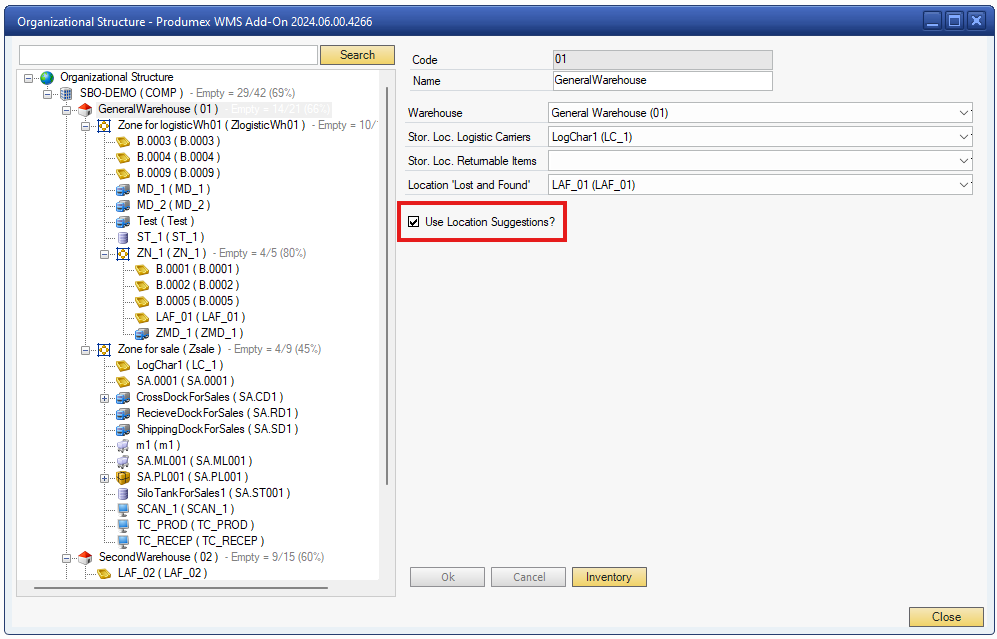
2. As a next step configurate the chosen Bin under the preferred Zone.
GeneralWarehouse (01) → Zone for logisticWh01 → B.0009
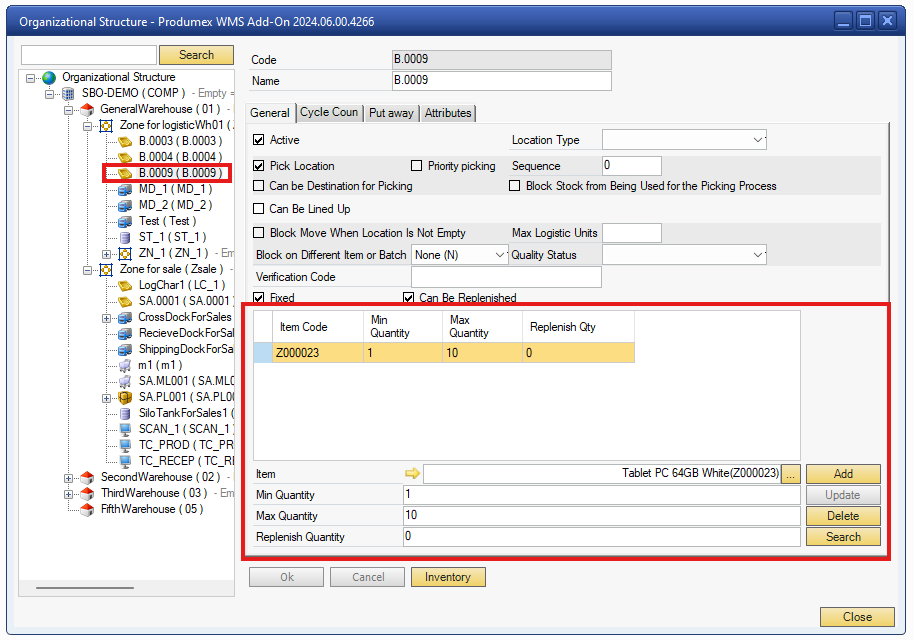
3. Select and configurate the default location on Item Master Data → Produmex → Inventory tab for your chosen Item.
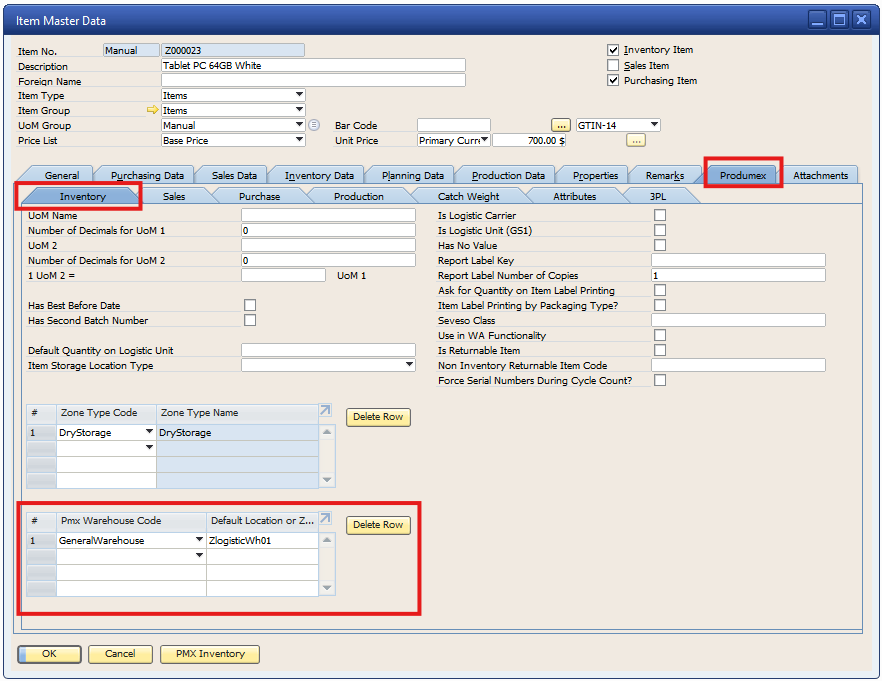
4. Open the Mobile Client to process the Ad Hoc Movement.
Logistics → Move → Ad Hoc Movement → Local Move → Full Logistic Unit
Now “Scan an SSCC”, in the example the Item's SSCC is “00000000000000000314”.
Clicking on the forward button, as expected the default location is suggested on the bottom of the Mobile Client as we configurated.
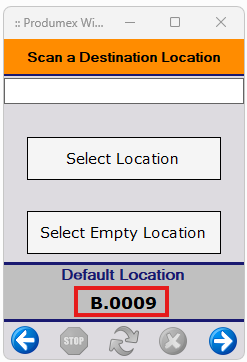
5. If you are selecting a Bin that is NOT the suggested location, the system will ask for a reason.Select and write your reason ant the Ad Hoc Movement will be done.
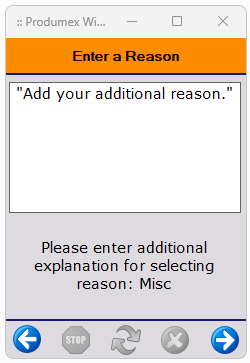
2.12. 3PL Invoicing tab
The 3PL Invoicing tab allows for defining the items to be used on the A/R invoices sent to the 3PL customers. 6 items can be defined, each corresponding to one type of 3PL price calculation:
- Inbound document count: price depending on the number of Goods Receipt POs
- Inbound line count: price depending on the number of lines in Goods Receipt POs
- Inbound item quantity: price depending on the item quantities received
- Outbound document count: price depending on the number of sales deliveries
- Outbound line count: price depending on the number of lines in sales deliveries
- Outbound item quantity: price depending on the item quantities delivered
Only non-inventory items can be selected and each item can be enabled or disabled. Prices corresponding to disabled items are added to the 3PL invoices.
In addition to the 6 types of 3PL price calculations, it is also possible to define 3PL price calculations based on the storage per location type. See section Location Types.

2.13. History Configuration tab
The History Configuration tab offers the possibility to define for which elements or aspects (which are stored in individual database tables) the changes have to be tracked in the context of Audit Trail.
This can be changes to characteristics of specific Organizational Structure Elements (e.g. a bin, a zone, a production line, … ) which need to be tracked, such as their name, zone type code, …
It may also be necessary to track changes to specific characteristics of items, such as e.g. the shelf life of an item for the various business partners of a company. This is shown in the example below, where it has been configured that for the table “Item shelf life for partner” it has to be recorded when the shelf life for a specific item for a specific business partner is added, updated or deleted.
These changes will then be tracked by the Produmex Office function Audit Trail.

2.14. Workflows tab
The Workflows tab of the Organizational Structure lists the workflows used by the system and makes it possible to adjust the workflows.
The the columns displayed in the table of workflows include:
- Name: Displays the name of the workflow.
- Version: Indicates the version of the workflow.
- Execution Type: Specifies the type of execution associated with the workflow.
- Objective: Provides a brief description of the workflow's purpose.
- Process Type: Indicates the related process type (e.g., inbound, outbound, production, printing).
- Details: Contains a working link to the workflow description in the wiki (if available).
- Type: Specifies the type of the workflow.
- Update Date Time: Displays the most recent update date and time of the workflow.
In the Filter field, users can narrow down their searches for Workflow scripts. the filter is not case sensitive, does not support wildcards, and has a maximum character limit of 100. As text is entered, the table will dynamically update, showing only the workflow lines where the Name column contains the entered text.
When editing a Workflow script after pressing the 'Edit Script' button, line numbers now help overseeing the code.
Modifying workflows can cause serious disruption of processes and even data corruption. Extreme Caution is advised. It is recommended that only experienced WMS Consultants attempt to modify these workflows. Boyum IT cannot be held responsible for issues resulting from externally modified workflows.

2.15. Config tab
The Config tab list some configuration that can be done for several processes and customer specific configuration can be stored here.

Google API key
- Route maps: An API key is needed to run the Google maps functionality.
- Each customer needs to get his own API key to be entered in the Google API key field.
- The Google API key must be created here and its status must be set to active.
For information about the ASOPLG and Create proposal settings click here.
For information on the Interface monitor settings click here.
2.16. Archiving tab
Produmex offers the option to manually archive data from closed documents in order to decrease database size and improve system performance.
The archiving process moves the selected data from closed documents into other tables in the same database or into a separate database, based on the configuration Archive databases and tables can be distinguished by the ‘_AR’ suffix in their name.
It is recommended to make a backup of the DB before doing the Archiving.
5.1.15.1. Configurations for archiving
Adjust the settings of the archiving process in the Archive Controller (Please see Extension Parameters / Archiving Controller).
5.1.15.2. Perform archiving
To execute the archiving process, go the Archiving tab in the Organizational Structure on the company level.
The Archive database field is prefilled based on the Use separate database setting in the Archiving Controller. When there is an _AR suffix at the end of the database name, the archiving is executed to a separate database.
The Days to keep live field is prefilled based on the Days to keep data in live database before moving to archive setting in the Archiving Controller. This number can be modified before executing the archiving.
Click on the Execute button to initiate the archiving process.

5.1.15.3. Steps before the first archiving
When executing the archiving the first time, the archiving database (if configured) and the archive tables will be created first.
Changing the Use separate database setting after the first archiving is not supported as it can cause issues.
Before creating the database and the tables, the system will ask for confirmation. Click on ‘Yes’ to proceed with the archiving.


After creating the archive tables, the system will ask for confirmation whether to continue with the archiving. Click Yes.

5.1.15.4. Archive tables
The system creates the following archive tables:
- PMX_AR_COHE
- PMX_AR_COLI
- PMX_AR_DLPL
- PMX_AR_DSST
- PMX_AR_IMHE
- PMX_AR_IMLI
- PMX_AR_INVD
- PMX_AR_LPLM
- PMX_AR_MOHE
- PMX_AR_MOLI
- PMX_AR_MVHE
- PMX_AR_MVLI
- PMX_AR_PIOP
- PMX_AR_PLHE
- PMX_AR_PLLI
- PMX_AR_PLLO
- PMX_AR_PLPH
- PMX_AR_PLPL
- PMX_AR_RTHE
- PMX_AR_RTLI
- PMX_AR_SSHH
- PMX_AR_SSHL
- PMX_AR_WAVE
- PMX_AR_WDET
5.1.15.5. Archiving process
After clicking the Execute button, the system starts the archiving. During the process, the system displays the following information:
- The time of the archiving
- The tables where the archiving was conducted
- The number of the archived documents
- The number of the live and archived picklists before and after the archiving, and the difference between them (the number of the newly archived picklists).

5.1.15.6. Archiving with a prior changeover date
Since during the archiving process only closed documents are archived, there are cases when an archiving with a longer history to keep than the previous one is desired. A confirmation window will pop up if the system finds that the new changeover date is prior to the previous one. Click OK to proceed.

5.1.15.7. Archived documents
Archived PDMX documents (move documents, picklists and picklist proposals) can be distinguished by the added ‘archived’ text in their title.
SAP navigation buttons are disabled in archived document screens.
Move screen

Pick list screen

Pick list proposal screen

3. Organizational Structure Element Settings
All Organizational Structure Elements have a Code and a Name field. Once the code is created, it cannot be changed.
3.1. Warehouse settings
On the warehouse level the following settings can be defined:

Warehouse
This is the link between the warehouse defined in Produmex and the warehouse in SAP Business One (Cfr. Administration → Setup → Inventory → Warehouses.)
Each SAP warehouse can only be linked once in Produmex warehouses.
Stor. Loc. logistic carriers
The location in the warehouse where the logistic carriers are located (in case you have indicated at the company level that logistic carriers have to be stored at one location per warehouse).
This location needs to be a pick location!
Stor. Loc. returnable items
The storage location for the returnable items. This is used when inventory returnable items are used.
Location ‘Lost and Found’
The ‘Lost and Found’ location for that warehouse.
All item differences counted during cycle counting (indirect cycle counting) will be moved to the Lost and found location in case this is set up on the CycleCountController.
Stock on storage locations set for Lost and found, logistic carriers, … are not taken in account to create pick list (proposals).
Use location suggestions?
Set whether location suggestions will be used for move in or to this warehouse.
This is used in the Location Suggestions functionality.
Organizational Structure: Zone settings
On the level of zones the following general settings and attributes can be defined.
General tab

Use for Zone Picking
If the setting is enabled, the zone can be selected during the Zone Picking Flow.
Zone Type
The Zone Type drop-down menu lists the zone types that are configured on the Zone Types tab of the Organizational Structure. More than one zone type can be added to the zone.
If the zone is the main zone and has one or more sub-zones, the zone type of the main zone also applies to its sub-zones. When a sub-zone is created, it automatically inherits the zone type of the main zone. For more information see Working with Zones and Zone Types.
Inherited
The Inherited column shows Yes if the zone type is inherited from the main zone. The inherited zone type cannot be deleted manually on the level of the sub-zone. If the zone type of the main zone is deleted, the system also deletes the given zone type of the sub-zones.
Attributes tab
On the Attributes tab you can add location attribute types and define attribute values for the zone.

Attribute Code
The Attribute Code drop-down menu lists those attribute types that are defined on the Produmex Location Attribute Types (PMX_OSAT) default form.
Attribute Value
In the attribute value field you can add values to the location attribute based on the convertor defined for the location attribute type.
- In case of location attribute types with convertor String, Int, Double and Date, you can manually add values in the Attributes Value field.
- In case of location attribute types with List convertor type, the Attribute Value drop-down menu lists the valid values for the selected location attribute type. The list of the drop-down menu can be defined on the Valid Values for Produmex Location Attributes (PMX_OAVV) default form.
Is Inherited Value
If the Is Inherited Value column shows True, the attribute type and the attribute value are inherited from the main zone.
For information on working with location attributes see Put Away Strategy and Move Restrictions.

3.3. Production line settings
In Produmex WMS a production line is always subordinate to a warehouse.
There are multiple ways of doing production:
- Production Flow: This flow handles the receipt from production and issue for production in the client
- Production Manager and Receipt from Production Flow: On the scanner/touchscreen the receipt for production is booked. The Production Manager handles the starting and stopping of the production order.
Note: Make sure you do not use the same production line for both flows.
The following settings can be defined for a production line:
3.3.1. General

Active
If it is enabled, the production line is active. A production line can only be active when the Input Location, Output Location and Rest Location fields are filled in.
Only 1 started production order allowed
If it is enabled, only one started production order is allowed for the production line.
The setting applies to the Production Manager and Receipt from Production Flow. The Production Flow always forces to have only one production order started on the production line.
Consume All Material on Production Line When Closing Production Order
With the end of the production all materials linked to the production line are issued, that is, no stock remains on the production line and the remaining quantity is 0.
The issued quantity can be equal to or higher than the planned quantity on the Issue for Production document.
Prerequisites:
- Only 1 started production order allowed setting on the level of the production line is enabled.
- The Production Type on the level of the production line is set to SPL_CONS_LOCK.
The setting applies to the following flows:
If the production order is closed on the Production Manager, by default the used quantity equals the on-line quantity and the remaining quantity is 0. The used quantities and the remaining quantities can be changed.
If the production order is closed during the Production Flow, by default the used quantity equals the on-line quantity and the rest quantity is zero on the Enter quantity to consume screen. The used quantities and the remaining quantities can be changed.
If the production order is closed during the Receipt from Production Flow, all materials on the production line are issued for the production order. The used quantity cannot be changed.
Note:
- The setting does not apply to the Put on Hold step during production.
- If the Use Waste? (Y/N) setting on the production controller is enabled, the remaining quantities are issued in a different document as waste materials.
Pick to location
The location where the needed ingredients are picked to. When this is not filled in, the system uses the input location. The Component Weighing Flow uses the Pick to location as input for the items to be weighed. The weighed items will be stored on the input location. Stock on a Pick to location is not taken in account to create picklist proposals.
Lock items picked to this location
If the setting is enabled, the Picking for Production Flow and the Picklist for Production Flow locks the items that are picked to this location. During the Component Weighing Production Flow the locked stock is moved to the input location after it was weighed.
On a Beas-WMS integration environment the stock is locked regardless the value of this setting.
Input location
The location where the needed ingredients are picked to. the production flows move stock from the input location to the production line. Stock on an input location is not taken in account to create picklist proposals.
Output location
The location where the finished products will be stored.
Rest location
Location to which the rest of used materials and ingredients are moved. It is possible to use the input location as rest location. In this case the remaining items will be ready to use for the next production order.
Parent production line
The parent production line is used if for instance the production is done in several steps. In this case the user can define the sequence of the production lines.
Production manager type
This is used when the processing of the production issues is done administratively. The setting is used only by the Production Manager.
It has two possible values:
- SPL_CONS_LOCK: When producing on the shop floor, the items to consume are not directly consumed, but they are locked. When processing the production order administratively, the system will use the locked stock as base for the consumption.
- MPL_CONS_INPUT: When the users do not want to perform the tasks to move the correct stock to the production line when producing, this option is used. When processing the production order administratively, all stock on the input location is used as base for the consumption. Furthermore, all production orders on production lines with the same input location will be processed in 1 time.
Current production order
The current production order for this production line (read-only)
Can be lined up
Some locations can be lined up. If a location is added here, it means the stock in this location is used directly, and does not need to be picked. This is usually used for tanks and/or silo’s.
However an output location of another production line can also be set as ‘lined up’. Now the produced items on the ‘previous’ (linked) production order can directly be used instead of picking the items.
Stock on possible lined up location is not taken in account to create pick list (proposals).
Produce ingredients
This option is used if a linked production order needs to automatically produce stock.
The prerequisites for this to work correctly, is that the lined up location is used as an output location on another production line. At the time of production on the shopfloor, a started production order needs to be found on the production line with as output location the lined up location.
Lined up locations
The current lined up locations
3.3.2. Cycle count

Allow location to be counted during cycle count
Is the location allowed to be counted?
Allow location to be counted during other operations
Is the location allowed to be counted during other operations? This means that when this location is used on certain flows, the system will check if a count is needed. If so, the system will ask the user to perform a count.
Locations needs to be counted now
When this option is enabled, the location will be counted, regardless of the other settings (Number of days, number of operations, …)
Count after X days
When a location has not been counted for the number of days defined here, the location needs to be counted. If the number is 0, this setting is not taken in account, and the setting on company level is taken.
Count after X operations
If the number of operations since the last count exceeds the defined number of operations, the location needs to be counted. If the number is 0, this setting is not taken in account and the setting on company level is taken.
Locked by (read-only field)
This field shows the key of the user that is locking the location, because he needs to count the location or is currently in process to count the location.
When a location is locked, it cannot be used in other processes.
The location is released by clicking the ‘unlock’ button.
Stock on locked locations is not taken in account to create pick list (proposals).
3.4. Packing line settings
On a packing line, items that have been picked on a movable location (picking cart) can be packed onto a logistic carrier to be shipped as a logistic unit with an SSCC.
Under the level of the packing line, a thin client element can be created directly (Mobile Client touchscreen mode).
3.4.1. General settings

Active
Set whether or not the packing line is active.
Block stock from being used for the picking process
If this setting is enabled, the stock on this location cannot be used to put on a proposal. Also when a pick list gets the allocation on location level, these locations are not taken in account.
The locations with this flag to true are added to the view PMX_DISALLOWED_LOCATIONS_FOR_PICKING
3.4.2. Cycle count

Allow location to be counted during cycle count
Is the location allowed to be counted?
Allow location to be counted during other operations
Is the location allowed to be counted during other operations? This means that when this location is used on certain flows, the system will check if a count is needed. If so, the system will ask the user to perform a count.
Locations needs to be counted now
When this option is enabled, the location will be counted, regardless of the other settings (Number of days, number of operations, …)
Count after X days
When a location has not been counted for the number of days defined here, the location needs to be counted. If the number is 0, this setting is not taken in account, and the setting on company level is taken.
Count after X operations
If the number of operations since the last count exceeds the defined number of operations, the location needs to be counted. If the number is 0, this setting is not taken in account and the setting on company level is taken.
Locked by (read-only field)
This field shows the key of the user that is locking the location, because he needs to count the location or is currently in process to count the location.
When a location is locked, it cannot be used in other processes.
The location is released by clicking the ‘unlock’ button.
Stock on locked locations is not taken in account to create pick list (proposals).
3.5. Dock settings
At the dock level the following settings can be made:
3.5.1. General

Active
Set whether or not the dock is active.
Loading & unloading
Whether the dock can be used for loading, unloading or both.
Pick location
Set whether a dock can also be a pick location (e.g. whether or not newly received goods that are still on the receiving dock can already be considered for picking)
Block stock from being used for the picking process
If this setting is enabled, the stock on this location cannot be used to put on a proposal. Also when a pick list gets the allocation on location level, these locations are not taken in account.
The locations with this flag to true are added to the view PMX_DISALLOWED_LOCATIONS_FOR_PICKING
Sequence
The order in which the products at this location will be used to compose a picking order. The pick locations with the lowest sequence number will be used first to complete the pick order.
This option is visible only if the checkbox of Pick location is checked in.
3.5.2. Cycle count

Allow location to be counted during cycle count
Is the location allowed to be counted?
Allow location to be counted during other operations
Is the location allowed to be counted during other operations? This means that when this location is used on certain flows, the system will check if a count is needed. If so, the system will ask the user to perform a count.
Locations needs to be counted now
When this option is enabled, the location will be counted, regardless of the other settings (Number of days, number of operations, …)
Count after X days
When a location has not been counted for the number of days defined here, the location needs to be counted. If the number is 0, this setting is not taken in account, and the setting on company level is taken.
Count after X operations
If the number of operations since the last count exceeds the defined number of operations, the location needs to be counted. If the number is 0, this setting is not taken in account and the setting on company level is taken.
Locked by (read-only field)
This field shows the key of the user that is locking the location, because he needs to count the location or is currently in process to count the location.
When a location is locked, it cannot be used in other processes.
The location is released by clicking the ‘unlock’ button.
Stock on locked locations is not taken in account to create pick list (proposals).
Organizational Structure: Bin location settings
On the level of bin locations the following settings can be defined.
General tab

Active
Enable the setting if the bin location is active.
Location Type
It is possible to define a location type and link it with a bin location. This information has no technical use, it is for information purposes only.
The location types to be displayed in the drop-down menu can be set in the Location types (PMX_LOTY) default form.
Pick Location
Enable the setting if the bin location is a pick location. If this is not the case the items that are stored at this location cannot be used for composing a shipment (order picking). A bin that is not used for picking (bulk location) can be used to store safety stock that is used to replenish various pick locations.
Priority Picking
If the bin location is a pick location, an additional Priority Picking checkbox is displayed. When this checkbox is checked, the bin location has a higher priority during stock allocation for picklists than other bin locations.
Can be Destination for Picking
Enable the setting if the bin location can be a destination destination location of the picking process. If the setting is enabled, it is possible to select this location as dock on the picklist.
Sequence
The order in which the products at this location are used to compose a picking order. The pick locations with the lowest sequence number are used first to complete the pick order.
Block Stock from Being Used for the Picking Process
If this setting is enabled, the stock on this location cannot be used to put on a proposal. When a picklist gets the allocation on a location level, these locations are not taken in account.
If the setting is enabled, replenishment orders do not take stock from locations.
If the setting is enabled, the location is added to the view PMX_DISALLOWED_LOCATIONS_FOR_PICKING.
Can be Lined Up
If the option is selected, the stock in the location is used directly and does not need to be picked. When there is a component to be lined up in the production order, the location can be selected during the Production flow.
Direct Consumption of Goods (Production Manager)
If the option Can Be Lined Up is set to true, this option is visible. By default, the lined up locations are not directly consumed when using the production manager (Production Receipt flow). The stock is locked for the production order, and it is consumed when stopping the production order using the production manager. If this option is set to true, the goods that are lined up on this location, are automatically consumed on the receipt from production.
Block Move When Location Is Not Empty.
If this setting is enabled, a move to this location when it is not empty is not allowed.
Block On Different Item or Batch
- None: Nothing will happen.
- Warn: Display a warning message when a different item or a different lot number will be added to that location. This warning is only when using the RF terminals.
- Block: Block the move when a different item or a different lot number will be added to that location.
Max Logistic Units
The maximum number of allowed logistic units (SSCCs).
If the stock is not on an SSCC, the system considers all of the stock as one logistic unit.
This blocks moves when the given value is exceeded, and this is also used when proposing locations on the devices.
Quality Status
This option forces a certain quality status on the location.
When adding/moving stock to the location, the system will check whether the quality status of the stock matches with the quality status of the location. If the quality status does not match, the following can happen:
- When booking a move through the handheld device or the Produmex inventory report, the system will automatically set the quality status of the stock to the quality status of the location and then it will perform the move.
- When booking a move with other processes, the system will not change the quality status of the stock and the move will be blocked.
When performing a direct cycle count on a location with a quality status, newly created stock will get this quality status.
How to set up location where only released stock can be stored, but avoid the quality status change when non-released stock is moved on the location
On the Quality status tab disable the Can be put on a pick location setting for every quality status that is not allowed on the given location. Then enable the pick location setting for the given bin location. Set the reception/quality control area as a non-pick location.
This way only the allowed quality statuses can be stored on pick locations.
Verification Code
The verification code is a unique code which can be used for verifying bin locations in the different flows. It has the same function as a bin location code, but it is more complex and its use is optional.
By default, you can verify the correct bin location on your scanner by scanning the bin location code or entering it manually, in which case an incorrect code may be entered. With a verification code, you can make sure that the correct bin location is verified because verification codes are not shown on the scanner and force the user to scan the barcode instead of manually entering the code.
Providing a verification code is optional and you can either use the verification code or the bin location code for verifying the correct bin location in the different flows:
- If a verification code is added to a bin location, you need to verify the bin location by scanning its verification code or scanning its bin location code.
- If no verification code is provided to the bin location, you need to verify the bin location by providing its bin location code.
Note: The verification code must be unique. It cannot be used by another bin, and it cannot be an existing location code. If you want to add a verification code to more than one bin location, make sure that each bin location has its own, unique verification code. If you add a verification code which is already used by another bin location, the system displays an error message.
Fixed
Indicates that the storage location is used for specific products. In this case a minimum, maximum quantity is defined for the item on that location.
When a location is fixed, the system will block local moves for other products into that location.
Can Be Replenished
Enables this option if the bin location can be taken in account for replenishment orders.
A minimum, maximum and replenish quantity needs to be set.
This can only be set when the location is a pick location.
Cycle Count tab

Allow location to be counted during cycle count
Is the location allowed to be counted?
Allow location to be counted during other operations
Is the location allowed to be counted during other operations? This means that when this location is used on certain flows, the system will check if a count is needed. If so, the system will ask the user to perform a count.
Locations needs to be counted now
When this option is enabled, the location will be counted, regardless of the other settings (Number of days, number of operations, …)
Count after X days
When a location has not been counted for the number of days defined here, the location needs to be counted. If the number is 0, this setting is not taken in account, and the setting on company level is taken.
Count after X operations
If the number of operations since the last count exceeds the defined number of operations, the location needs to be counted. If the number is 0, this setting is not taken in account and the setting on company level is taken.
Locked by (read-only field)
This field shows the key of the user that is locking the location, because he needs to count the location or is currently in process to count the location.
When a location is locked, it cannot be used in other processes.
The location is released by clicking the ‘unlock’ button.
Stock on locked locations is not taken in account to create pick list (proposals).
Put Away tab
This is used in the Location Suggestions functionality.

Item Location Type
This can be used to link a location to an item.
An item can also have an item storage location type.
When locations need to be suggested, and an item has a location item type selected, only locations with the same item location type are allowed.
The list of item storage location types is stored in the PMX_ISLT default form.
Put Away Zone
This stores for a certain storage location:
- What the zones are where the items can be placed
- Or to what put away zone a location belongs to
The list of the Put Away Zone drop-down menu is defined by the Put away zone (PMX_PAZO) default form.
Sort the Pick Sequence Descending?
Locations belong to a put away zone. How are locations within this zone sorted? Pick sequence descending or ascending?
Location Belongs to Put Away Zone?
Does this location belong to a put away zone? If it is not checked, it means that when goods need to be put away for the current location, the system should look for locations that belong to this zone.
If it is checked, the location belongs to this put away zone.
Sequence number
This is the sequence number for the put away zones. It defines the order in which locations in a put away zone needs to be retrieved.
For more information see Location Suggestions.
Attributes tab
On the Attributes tab you can add location attribute types and define attribute values for the bin location.

Attribute Code
The Attribute Code drop-down menu lists those attribute types that are defined on the Produmex Location Attribute Types (PMX_OSAT) default form.
Attribute Value
In the attribute value field you can add values to the location attribute based on the convertor defined for the location attribute type.
- In case of location attribute types with convertor String, Int, Double and Date, you can manually add values in the Attributes Value field.
- In case of location attribute types with List convertor type, the Attribute Value drop-down menu lists the valid values for the selected location attribute type. The list of the drop-down menu can be defined on the Valid Values for Produmex Location Attributes (PMX_OAVV) default form.
Is Inherited Value
If the Is Inherited Value column shows True, the attribute type and the attribute value are inherited from the zone.
For information on working with location attributes see Put Away Strategy and Move Restrictions.

3.7. Movable location settings
A movable location is an intermediate storage location: this can be a cart, a movable rack, etc. A movable location allows the operator to pick one or more orders and pack them onto a logistic carrier at another location (packing station).
3.7.1. General

In the organization structure it is possible to set the code and name of a moveable location and define whether or not it is active.
Stock on movable locations is not taken in account to create pick list (proposals).
3.7.2. Cycle count
A moveable location can also be used in the cycle counting and has the same settings as a bin location.

Allow location to be counted during cycle count
Is the location allowed to be counted?
Allow location to be counted during other operations
Is the location allowed to be counted during other operations? This means that when this location is used on certain flows, the system will check if a count is needed. If so, the system will ask the user to perform a count.
Locations needs to be counted now
When this option is enabled, the location will be counted, regardless of the other settings (Number of days, number of operations, …)
Count after X days
When a location has not been counted for the number of days defined here, the location needs to be counted. If the number is 0, this setting is not taken in account, and the setting on company level is taken.
Count after X operations
If the number of operations since the last count exceeds the defined number of operations, the location needs to be counted. If the number is 0, this setting is not taken in account and the setting on company level is taken.
Locked by (read-only field)
This field shows the key of the user that is locking the location, because he needs to count the location or is currently in process to count the location.
When a location is locked, it cannot be used in other processes.
The location is released by clicking the ‘unlock’ button.
Stock on locked locations is not taken in account to create pick list (proposals).
3.8. Silo/Tank settings
At the level of silo or tank the settings below can be defined.
The Consumption Algorithm is a mandatory setting, make sure that it is properly set.
3.8.1. General

Active
Set whether or not it is active.
Can be lined up
If the option is selected, the stock in the location is used directly and does not need to be picked. When there is a component to be lined up in the production order, the location can be selected during the Production flow.
Direct consumption of goods (Production manager):
If the option ‘Can be lined up’ is set to true, this option is visible. By default the lined up locations are not directly consumed when using the production manager (ProductionReceipt flow). The stock is locked for the production order, and it is consumed when stopping the production order using the production manager. If this option is set to true, the goods that are lined up on this location, will be automatically consumed on the receipt from production.
Sequence
The order in which the products at this location will be used to compose a picking order. The pick locations with the lowest sequence number will be used first to complete the pick order.
Max quantity
The maximum quantity. This is for informational purposes.
This will not block a move when quantity will be exceeded.
Pick location
Set whether or not it can be used as a pick location
Block stock from being used for the picking process
If this setting is enabled, the stock on this location cannot be used to put on a proposal. Also when a pick list gets the allocation on location level, these locations are not taken in account.
The locations with this flag to true are added to the view PMX_DISALLOWED_LOCATIONS_FOR_PICKING
Block move when location is not empty.
If set, a move to this location when is not empty is not allowed.
Block on different item or batch
- None: Nothing will happen
- Warn: Display a warning message when a different item or a different lot number will be added to that location. This warning is only when using the RF terminals.
- Block: Block the move when a different item or a different lot number will be added to that location.
Fixed
Set whether the silo/tank is reserved for a specific product and if so which are the minimum and maximum quantities.
3.8.2. Consumption Algorithm

The consumption algorithm by which the contents of the silo/tank is consumed: differs for fluids or solids. Mandatory setting.
- FEFO: First to expire, first out
- Silo: Bottom layer (FIFO)
- based upon the batch ID
- based upon the move timestamp to the silo
- Tank: Multi-layer (Consume a part from each batch)
Tank: Multi-layer
In the following case, if a stock item quantity is less than 1% of the total inventory at the storage location,
the entire stock item will be used, even if it exceeds the required quantity.

3.8.3. Cycle Count

Allow location to be counted during cycle count
Is the location allowed to be counted?
Allow location to be counted during other operations
Is the location allowed to be counted during other operations? This means that when this location is used on certain flows, the system will check if a count is needed. If so, the system will ask the user to perform a count.
Locations needs to be counted now
When this option is enabled, the location will be counted, regardless of the other settings (Number of days, number of operations, …)
Count after X days
When a location has not been counted for the number of days defined here, the location needs to be counted. If the number is 0, this setting is not taken in account, and the setting on company level is taken.
Count after X operations
If the number of operations since the last count exceeds the defined number of operations, the location needs to be counted. If the number is 0, this setting is not taken in account and the setting on company level is taken.
Locked by (read-only field)
This field shows the key of the user that is locking the location, because he needs to count the location or is currently in process to count the location.
When a location is locked, it cannot be used in other processes.
The location is released by clicking the ‘unlock’ button.
Stock on locked locations is not taken in account to create pick list (proposals).
Configure Mobile Client on Organizational Structure
A thin client is a fixed or mobile operator station (touchscreen, handheld terminal, etc.), by which the operator can interact and communicate with Produmex WMS. On the thin client level the following settings can be made:
1. Workflow tab

Workflow
Next you can also assign a thin client to a “workflow”. A workflow is a sequence of actions to execute a certain operation, e.g. Reception, Picking, Production, Shipping, …
Parameter set
For certain flows extra parameters can be set. When selecting a parameter set, the options to enter are available below.
Number of items in sales unit column name
Define here the column name of the column that stores the number of items in the sales unit, defined on the item master data. By default ‘NumInSale’ is used. If you have a UDF to store this value, you can provide the name of the UDF.
Admin password
Provide here the password that will be used to unlock the administrator functionality in the showroom application. By default the password is ‘produmex’
2. Warehouses tab

Thin clients created under a warehouse will see the warehouse locations and orders for the warehouse by default. On the ’Warehouse’ tab additional warehouses can be assigned for the thin client. If a warehouse is assigned for the thin client, its locations and orders can be seen on the client. It is not possible to disable the parent warehouse for the thin client by unticking the checkbox to the parent warehouse.
3. Users tab

By default every SBO user can use the thin client if there is a free license that can be allocated for the thin client. However it is possible to assign only certain users for a thin client.
If there is at least one assigned user, only assigned users can login on the thin client. In case no users are assigned, ALL users are allowed to access the flow.
On the Users tab every SAP Business One user is listed. Check the ’Assigned’ checkbox in to assign an user.
4. Default Scales tab

On the Default Scales tab you can set the default scales for users that they use during the Weighing Flow. For more information click here.
3.10. Printer settings
For printers the following settings can be set:

Windows printer name
The printer name by which the printer is referred to in Windows
Page size
The default page size for the printer
Active
Set whether or not the printer is active.
Default
Set whether it is the default printer
3.10.1. Printer search path
These printers are used in flows on the devices.
The system will get the printer with the same page size as the report that needs to be printed.
First the system looks for printers below the device (In the organizational structure). Next the system will look if it can find a printer in higher levels, starting from the device.
If the system still does not find a printer, the system will check for printers starting from a location.
Which location is taken will depend on the flow where the report will be printed.
Example: For a reception, the location will be the receiving dock.
The same search pattern as for the device is used. So first look for a printer below the location, next on higher levels.
When the system finds several printers on the same level, and there is 1 printer defined as default, it will take that printer. Otherwise the system will take the first printer it finds on that level.
Remark: When the system searches for printers on higher levels, it will not go back to a lower level to search for a printer.
3.11. Weighing room settings
At the level of a weighing room, the following settings can be defined:
3.11.1. General tab

Active
Set whether the weighing room is active or not.
Input location
The location where the ingredients that needed to be weighed are picked. During the weighing process, stock will be moved to the weighing room from the input location.
Output location
The location where the weighed goods will be moved.
A typical setup is when the input location of the weighing room is the pick to location or the input location of the linked production line and the output location of the weighing room is the input location of the linked production line.
Weigh strategy
The weigh strategy defines whether the stock to weigh can be selected based on the weigh order or the item code during the Weigh flow. For more information click here.
3.11.2. Cycle Count tab

Allow location to be counted during cycle count
Is the location allowed to be counted?
Allow location to be counted during other operations
Is the location allowed to be counted during other operations? This means that when this location is used on certain flows, the system will check if a count is needed. If so, the system will ask the user to perform a count.
Locations needs to be counted now
When this option is enabled, the location will be counted, regardless of the other settings (Number of days, number of operations, …)
Count after X days
When a location has not been counted for the number of days defined here, the location needs to be counted. If the number is 0, this setting is not taken in account, and the setting on company level is taken.
Count after X operations
If the number of operations since the last count exceeds the defined number of operations, the location needs to be counted. If the number is 0, this setting is not taken in account and the setting on company level is taken.
Locked by (read-only field)
This field shows the key of the user that is locking the location, because he needs to count the location or is currently in process to count the location.
When a location is locked, it cannot be used in other processes.
The location is released by clicking the ‘unlock’ button.
Stock on locked locations is not taken in account to create pick list (proposals).
3.12. Scale settings
Define the scale under a weighing room,dock or a packing station. One scale can only belong to a single weighing room/dock/packing station.
At the scale level the following settings can be defined:

Active
Set whether the weighing room is active or not.
Scale definitions
Define the scale on the Scale definitions field.
If the scale is connected without the ScaleComm service, define it with the one of the following formulas:
- Direct connection: com:/ /Port?Baudrate,Databits,Parity,Stopbits
Example:com://COM3?9600,8,N,1
- Local network: tcp:/ /IP address
Example:tcp://192.168.1.5:4001
If the scale is connected by using the ScaleComm service, tick the Use as a service checkbox and define the scale with the following formula:
- http:/ /URL of the server where the service runs/scale code (OSE)/communication parameters
Example:http://192.168.1.2:9991/SCL01/com://COM3?9600,8,N,1
Uom
Select the unit of measurement of the scale from the Uom dropdown list.
Minimum weight
Enter the minimum weigh of the scale in the Minimum weigh field.
Maximum weight
Enter the maximum weigh of the scale in the Maximum weigh field.
Accuracy
Enter the accuracy of the scale to the Accuracy field.
Example: If the number of decimals is 2 – Accuracy: 0.01
Scale commands
Define the scale commands. Select the command type. The following command types are supported:
- Set tare
- Set zero
- Get weight
- Weight return
The ‘Zero return’ and the ‘Tare return’ commands are not supported yet but are reserved for future use.
Add the description to the Description field and the command to the Command format field.
Command format
Please refer to the user manual of the scale to see the command.
The syntax of the Weight return result string should be a regular expression.
Example:
Weight return string from the scale manual:
<LF><p>w1w2w3w4w5w6<dp>w7w8u1u2<CR><LF>H1H2H3<CR><ETX>
Weight return string defined for the scale on the Organizational Structure:
\x0a *(?'weight'.+)(?'uom'..)\x0d\x0a.+\x0d\x03
3.12.1. Defining multiple scales through one port
Produmex WMS Organizational Structure
First create a ‘scale’ type element in the Organizational Structure of Produmex WMS for the port.
Add a unique code and name. Example:
PORT, Port for scale
Define the port on the Scale definitions field with one of the following formulas:
- Direct connection: com:/ /Port?Baudrate,Databits,Parity,Stopbits
Example:com://COM3?9600,8,N,1
- Local network: tcp:/ /IP address
Example:tcp://192.168.1.5:4001
Do not check the ‘Use as service’ checkbox.
The ScaleComm service will establish the connection to the port based on the configuration file of the ScaleComm service.
The scales connected through the port will be identified based on the sent command.
Select the command type and add the scale codes and the scale command to the Command format field using the following formula: scale code;command;scale code;command
Example:
Get weight command:
scale01;S6R$;scale02;S7R$
Where:
- ‘scale01’ = scale code of the first scale
- ‘S6R$‘= get weight command of the first scale
- ‘scale02’ = scale code of the second scale
- ‘S7R$’ = get weight command of the second scale
Weight Return command:
(?'weight'.+)\x0d\x0a;(?'weight'.+)\x0d\x0a
The order and the number of the scale commands must be the same as in the 'Get weight command'.

ScaleComm service
Open the configuration file of the ScaleComm Service.
Add the code of the port defined in the Organizational Structure as the value for ScalesCodes. Example:
<add key="ScalesCodes" value="PORT" />
Make sure that the ‘Skip Polling’ option is set to ‘False’ and adjust the ‘Polling Interval’ if needed.
Scale weigh result
Open the Scale Weigh Result user table via the following path: Tools> Default forms. Add the scale codes defined on the Command format field as the ‘Code’.
When the ScaleComm Service runs, it will add the weight to the ‘Weigh’ field of the matching scale.
